
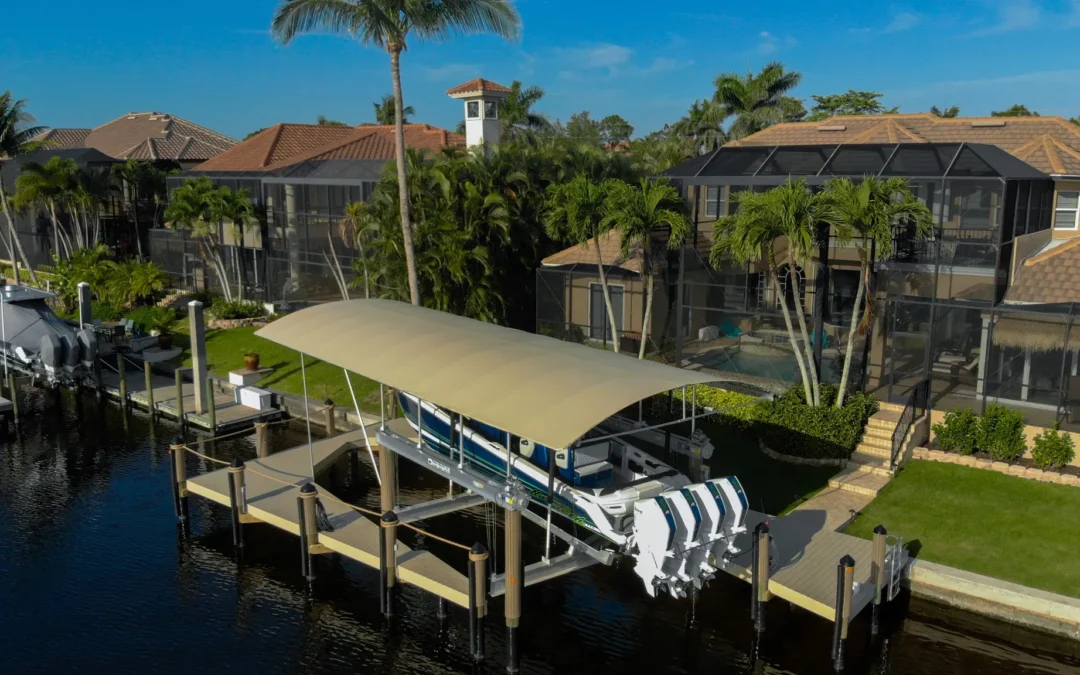
Your pontoon sits on a lift for a reason: to keep the hull out of the water between trips. But what about everything above the waterline? Without a canopy overhead, UV rays bake the upholstery, afternoon downpours fill the deck, and bird droppings turn your gel coat into a scrubbing project every weekend. A pontoon boat lift canopy solves all of that by covering your boat while it sits on the lift, so you spend less time cleaning and more time cruising.
Request your free estimate to find out which canopy style and size fits your pontoon lift.
This guide walks you through the canopy styles available, the materials that hold up in coastal weather, how to measure your lift for a proper fit, and the features that matter most if you keep your boat in Southwest Florida. By the end, you will know exactly what to look for and what to avoid before you spend a dollar.
What Is a Pontoon Boat Lift Canopy?
A pontoon boat lift canopy is a fabric-and-frame covering system that mounts directly to your boat lift. It sits above your pontoon while the boat is raised on the lift, shielding the deck, seats, console, and electronics from sun, rain, wind, and debris. Unlike a snap-on boat cover that wraps tightly around the hull, a canopy provides overhead clearance, which means you can walk around on the boat and board without removing anything first.
The structure has two main parts: a metal frame (usually aluminum) that bolts to the lift’s upright beams, and a marine-grade fabric cover that stretches across the frame. Some designs include side curtains for additional coverage. The canopy stays in place year-round except during major storms, when most Florida owners remove the fabric as part of their hurricane protocol.
Why Does Every Pontoon Owner on a Lift Need One?
If your pontoon sits on a lift without any overhead protection, you are exposing it to damage that adds up fast. Here is what a canopy prevents.
UV Damage to Seats and Gel Coat
Florida averages over 230 sunny days a year. That constant UV exposure fades seat vinyl, cracks dashboard plastics, and dulls gel coat finishes within a couple of seasons. Re-upholstering a pontoon runs anywhere from $2,000 to $5,000, depending on the layout. A canopy blocks the majority of that UV exposure and keeps interior surfaces looking new for years longer.
Rainwater, Leaves, and Bird Droppings
Without a cover, every afternoon storm fills your deck with standing water. Leaves and pollen settle into corners and create mildew. Bird droppings etch into gel coat if left sitting in the sun. A canopy channels rain off the fabric and away from the boat, keeping the deck dry and cutting your pre-trip cleaning time down to almost nothing.
Higher Resale Value
Boats that have been stored under a canopy show noticeably less wear than uncovered boats of the same age. If you plan to sell your pontoon down the road, a canopy helps protect the condition that buyers care about most: clean seats, clear vinyl, and a bright finish. The cost of the canopy is a fraction of the value it preserves.
What Pontoon Boat Lift Canopy Frame Styles Are Available?
The frame is the backbone of your canopy. It determines how much coverage you get, how the system handles wind, and how it looks on your dock. Four main styles cover the majority of pontoon lift setups.
Flat-Top Canopy Frames
A flat-top frame sits level across the top of the lift. The fabric stretches tight, creating a clean, low-profile look. This style works well for lifts under covered docks or in areas with height restrictions. The tradeoff is that flat fabric can hold small amounts of standing water after heavy rain if the tension is not maintained. For pontoon owners in drier climates or those who want a simple, no-fuss setup, the Antigua flat-top frame gets the job done at a lower price point.
V-Shape (Peaked) Canopy Frames
A peaked frame uses a center ridge that creates a “V” shape, similar to a roof. Water runs off both sides instead of pooling, which makes this style a better fit for areas with frequent rain. The Barbados frame is a good example: it features a traditional V-shape with a 12 to 30 inch overhang that extends coverage past the edges of the lift. This extra overhang shields your boat from angled rain and provides additional shade on the dock.
Full-Coverage Canopy Frames
Full-coverage frames are designed to wrap further around the boat, sometimes including drop-down sides. The Cayman frame is one of the most versatile options in this category. It is built for boats without hard tops and works in no-build zones where traditional canopy structures may not be allowed. If maximum protection from every angle is your priority, a full-coverage frame gives you the closest thing to an enclosed garage for your pontoon.
Heavy-Duty I-Beam Frames
Standard canopy frames use round aluminum tubing. I-beam frames replace that tubing with solid I-beam construction, the same structural shape used in bridges and buildings. The Dominica with I-beam is the strongest option available, built for maximum wind resistance with four uprights per side instead of the industry-standard two or three. If your dock faces open water, sits in a high-wind corridor, or you simply want the strongest frame money can buy, an I-beam frame is worth the investment. Learn more about how I-beam frames compare to standard tube frames.
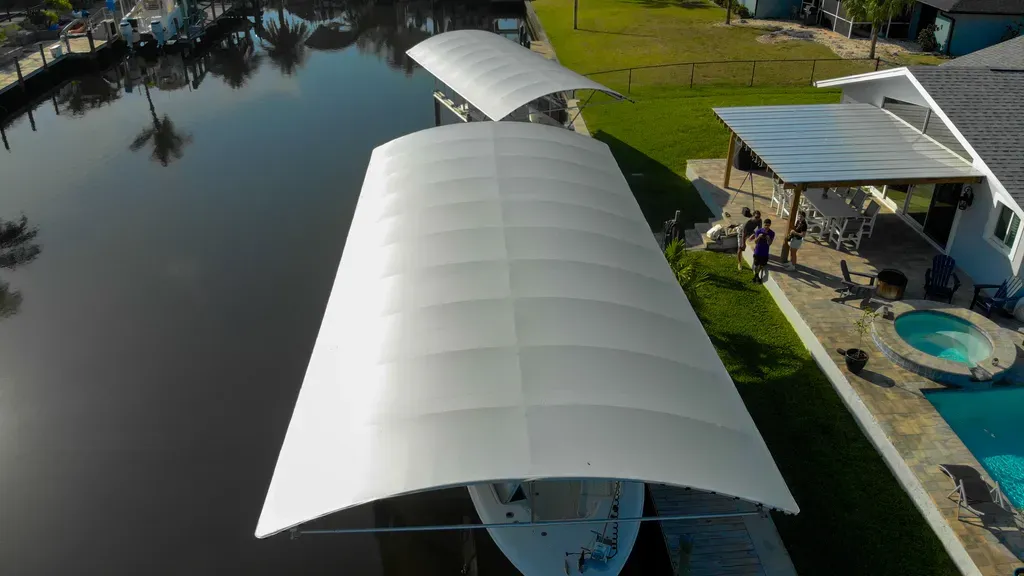
How Do You Choose the Right Canopy Frame for Your Pontoon?
Picking a frame style comes down to three factors: your dock’s exposure to wind and weather, the height and beam of your pontoon, and any local building restrictions.
| Factor | Best Frame Style | Why |
|---|---|---|
| Open-water exposure, high wind | I-Beam (Dominica) | Strongest wind resistance, four uprights per side |
| Frequent heavy rain | V-Shape (Barbados) | Peaked roof sheds water quickly, prevents pooling |
| No-build zone or tight space | Full-Coverage (Cayman) | Flexible design works where traditional frames cannot |
| Covered dock or height restriction | Flat-Top (Antigua) | Low profile fits under existing structures |
| Maximum all-around protection | Full-Coverage + side curtains | Blocks sun, rain, and wind from every direction |
If you are not sure which style fits your setup, a professional measurement visit will clear things up quickly. Get a free estimate that includes an on-site assessment of your lift, dock layout, and exposure.
Which Materials Hold Up Best in Coastal Weather?
The frame gets your canopy standing. The fabric and hardware determine how long it lasts. In Southwest Florida, where salt air, UV radiation, and summer storms are constant, material choice is not something to cut corners on.
Marine-Grade Canopy Fabric
The industry standard for quality boat lift covers is Patio 500 vinyl-laminated polyester. This fabric is waterproof, UV-resistant, heat-reflective, and resistant to tearing and mildew. It comes in around 30 color options so you can coordinate with your home, dock, or HOA requirements. Cheaper fabrics might look fine at first, but they fade, crack, and develop mildew within a year or two of Florida sun exposure. Patio 500 is engineered specifically for marine use and backed by a proven track record in coastal climates.
Thread and Stitching
Even the best fabric will fail at the seams if the thread is not up to the job. GORE TENARA sewing thread is a lifetime-rated thread made from expanded PTFE. It does not degrade in UV light, does not rot in moisture, and does not weaken from salt exposure. When a manufacturer backs their stitching with a lifetime guarantee, that is usually the thread they are using.
Frame Material: Aluminum vs. Steel
Marine-grade aluminum is the standard for canopy frames in coastal areas. It is lightweight, naturally corrosion-resistant, and strong enough to handle sustained wind loads. Steel frames cost less upfront but rust quickly in salt air, even with powder coating. For a pontoon lift in Southwest Florida, aluminum is the only practical choice for a frame that will last more than a few seasons.
Straps, Hardware, and Fasteners
The small parts matter. Polyester straps outlast vinyl straps in UV and salt conditions. Stainless steel fasteners resist corrosion far better than zinc-plated hardware. When comparing canopy quotes, ask specifically about the strap material and fastener grade. These details separate a system that lasts 10 years from one that starts rusting in 2.
Ready to see which materials and frame style fit your pontoon lift? Request a free estimate for a custom recommendation.
How Do You Measure Your Lift for a Pontoon Canopy?
A canopy fits the lift, not the boat. That is the most common mistake buyers make: they measure their pontoon’s beam and length, then order a canopy based on those numbers. The canopy frame attaches to the lift’s vertical beams, so the lift dimensions are what determine the size you need.
Step-by-Step Measuring Process
- Measure the inside width of the lift: Go from the inside edge of one vertical beam to the inside edge of the opposite beam. This is the span your canopy frame needs to cover.
- Measure the length of the lift beams: Measure along the top of the main horizontal beams from end to end. This tells you how long the canopy needs to be.
- Check vertical clearance: With your pontoon raised on the lift, measure from the highest point of the boat (usually the Bimini top or radar arch) to where the canopy frame would sit. You need enough clearance to walk around comfortably and avoid contact when the boat is raised.
- Note any obstructions: Look for pilings, dock lights, electrical conduit, or other structures that could interfere with the frame mounting. Write down their locations and heights.
If your lift or dock has an unusual layout, or if your pontoon has a tall hard top, a standard frame may not fit. Custom sizing solves this. Every Coastline canopy is custom-made to the exact dimensions of your lift, which eliminates the guesswork and guarantees proper coverage. Read our full guide to choosing the right cover size for more detail on getting accurate measurements.
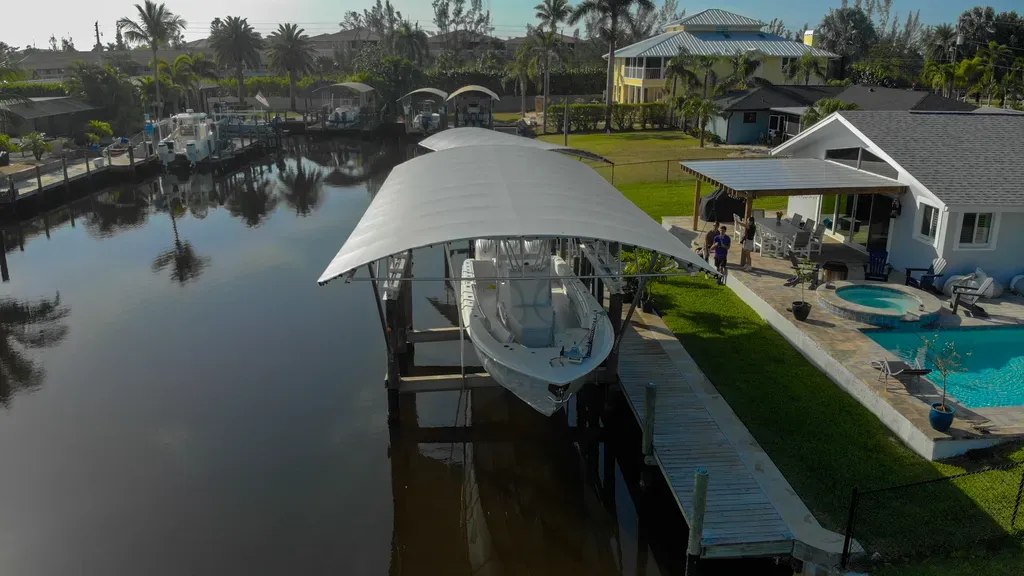
What Features Matter Most in Florida?
A canopy that works fine in Michigan will not necessarily hold up in Southwest Florida. The combination of extreme UV, salt air, daily rain showers, and annual hurricane threats puts specific demands on a canopy system. Here are the features to prioritize.
Wind Resistance
Florida’s summer storms bring sudden gusts that can exceed 60 mph. Your canopy needs a frame that can handle that without bending or pulling away from the lift. I-beam construction and four-upright designs provide the highest wind ratings. Reinforced welding at all connection points is another detail that separates a storm-ready canopy from one that folds under pressure. For more on this topic, see our guide on choosing a wind-resistant boat lift canopy.
Hurricane Removal Capability
No canopy is designed to survive a direct hurricane hit. The fabric becomes a sail in sustained high winds and will damage the frame, the lift, or both. A proper Florida canopy system should be designed for easy fabric removal when a hurricane warning is issued. Some providers, including Coastline, offer a hurricane protocol service that handles pre-storm removal, storage, and post-storm reinstallation so you do not have to do it yourself. Check our hurricane season checklist for a full preparation plan.
Ventilation
Florida humidity creates the perfect conditions for mold and mildew growth. A canopy that traps moist air underneath does more harm than good. Look for designs that allow airflow through vented gables or open sides. Good ventilation keeps moisture from settling on your boat’s surfaces and prevents that musty smell that comes from stagnant, humid air under a sealed cover.
Water Drainage
Standing water on top of the fabric stretches the material, adds weight stress to the frame, and breeds mosquitoes. A properly pitched canopy, like the V-shape Barbados design, sheds water immediately. If you go with a flatter frame style, make sure the fabric tension is maintained regularly so water runs off instead of pooling.
What Does a Pontoon Boat Lift Canopy Cost?
Pricing for pontoon canopy systems varies based on the frame style, fabric grade, size, and whether professional installation is included. Because every lift and dock setup is different, most quality providers work on a custom quote basis rather than listing fixed prices online. Here is a general breakdown of what affects the total cost.
Frame and Fabric Tier
Entry-level systems with standard round-tube frames and basic fabric start at a lower price point but may not include the wind resistance or UV protection needed for Florida conditions. Premium systems with I-beam frames, Patio 500 fabric, and GORE TENARA stitching cost more upfront but come with longer warranties and significantly better durability. Over a 10-year span, the premium option often costs less per year because you are not replacing parts or the entire system early. Read our full cost breakdown for more detailed pricing guidance.
Installation
Professional installation adds to the total cost but is worth it. A trained crew will level the frame, tension the fabric correctly, and verify all mounting points are secure. Improper installation can void your warranty and leave the canopy vulnerable to the first strong wind. DIY installation is an option for handy boat owners, but most pontoon owners in Florida prefer having pros handle it, especially for I-beam or full-coverage systems. See our installation guide for what the process involves.
Ongoing Costs
Replacement covers every 5 to 10 years (depending on fabric quality), annual hurricane removal service, and occasional hardware replacement are the main recurring costs. These are minor compared to the cost of repairing UV-damaged upholstery, replacing corroded electronics, or buffing out a faded gel coat.
Want an exact number for your setup? Request a free estimate and we will measure your lift, recommend a style, and provide a detailed quote with no obligation.
What Warranty Should You Expect?
A strong warranty tells you how confident the manufacturer is in their product. When comparing canopy providers, look at three separate warranty components.
| Component | Industry Average | What to Look For |
|---|---|---|
| Frame | 3 to 5 years | 10 years or more |
| Fabric/Canopy | 2 to 3 years | 5 years or more |
| Stitching | Often not covered | Lifetime guarantee |
A 10-year frame warranty, 5-year canopy warranty, and lifetime stitching guarantee is the highest tier you will find in this market. If a provider does not list their warranty terms clearly, ask before signing. Our warranty guide explains what to look for and what common exclusions to watch out for.
What Are the Most Common Mistakes to Avoid?
Buying a pontoon canopy is straightforward once you know what to look for, but a few common mistakes trip up first-time buyers.
- Measuring the boat instead of the lift: The canopy mounts to the lift frame, not the boat. Measuring the pontoon’s beam will give you the wrong dimensions.
- Choosing the cheapest option: Budget canopies made with non-marine fabrics and lightweight frames rarely last more than two Florida summers. The replacement cost usually exceeds what a quality system would have cost from the start.
- Ignoring compatibility: Not every canopy frame fits every lift brand. Confirm that the system you are buying is designed for your specific lift model before placing an order. Our compatibility guide covers how to check this.
- Skipping professional installation: An improperly installed canopy can stress the lift mechanism, void the manufacturer’s warranty, and fail during the first storm.
- No hurricane plan: If you live in Florida and do not have a plan for removing the canopy fabric before a hurricane, you risk losing the canopy, the frame, and potentially your lift.
How Do You Maintain Your Pontoon Boat Lift Canopy?
A quality canopy does not need much upkeep, but a few regular habits will extend its life significantly. For a more detailed maintenance plan, read our guide on maintaining your boat lift cover in Florida’s climate.
Fabric Care
Rinse the fabric with fresh water every two to three weeks to wash off salt residue and pollen. For stubborn stains like bird droppings or mildew spots, use a soft brush with mild soap and water. Avoid pressure washers and harsh chemical cleaners, which strip the fabric’s protective coating.
Frame Inspection
Check the frame hardware twice a year for loose bolts, worn fittings, or early signs of corrosion. Marine-grade aluminum resists rust, but fasteners and connection points can still corrode over time in salt air. Catching a loose bolt early is a five-minute fix; ignoring it can lead to frame damage during a storm.
Seasonal Preparation
Before hurricane season (June through November), confirm your storm removal plan. Know how to disconnect the fabric from the frame, or schedule your provider’s removal service in advance. After the season, inspect the frame and fabric for any wear and re-tension the cover if needed. Check our seasonal care guide for a complete month-by-month maintenance calendar.
Frequently Asked Questions
Can I put a canopy on my existing boat lift?
Yes. Most canopy systems are designed to retrofit onto existing lifts. The key is matching the frame style and size to your lift’s dimensions and brand. A professional measurement visit confirms compatibility before you commit to a purchase.
How long does a quality canopy last in Florida?
With marine-grade materials and regular maintenance, a canopy frame can last 15 to 20 years. The fabric cover typically needs replacement every 5 to 10 years, depending on sun exposure and maintenance habits. Premium fabrics like Patio 500 with GORE TENARA stitching tend to last toward the upper end of that range.
Is a boat lift canopy better than a fitted boat cover?
They serve different purposes. A fitted cover wraps tightly around the boat and is good for trailered storage or short-term protection. A lift canopy provides overhead protection while allowing airflow, which prevents mildew. It also lets you board and use the boat without removing anything first. For a pontoon that lives on a lift, a canopy is the more practical, everyday solution.
Do I need to remove the canopy for every storm?
Not for every storm. Routine rain and moderate wind are exactly what the canopy is built to handle. However, when a hurricane warning or tropical storm warning is issued, you should remove the fabric cover from the frame. The large surface area acts like a sail in sustained high winds and can damage the frame, the lift, or the dock. A pre-arranged hurricane removal service takes care of this for you.
How much does a pontoon boat lift canopy cost?
Pricing depends on the frame style, fabric grade, lift size, and whether professional installation is included. Entry-level systems with standard round-tube frames start lower but may lack the wind resistance and UV protection needed for Florida conditions. Premium systems with I-beam frames, Patio 500 fabric, and GORE TENARA stitching cost more upfront but last significantly longer, often making them the better value over a 10-year span. Because every lift setup is different, most quality providers work on a custom quote basis. Request a free estimate for an exact price based on your lift dimensions and preferred style.
What color canopy should I choose?
Lighter colors (white, beige, gray) reflect more sunlight and keep the area underneath cooler. Darker colors hide dirt better between cleanings. Either way, make sure the fabric has strong UV resistance so the color holds up over time. Many Florida boat owners choose a color that matches their home or dock to keep things looking consistent.