
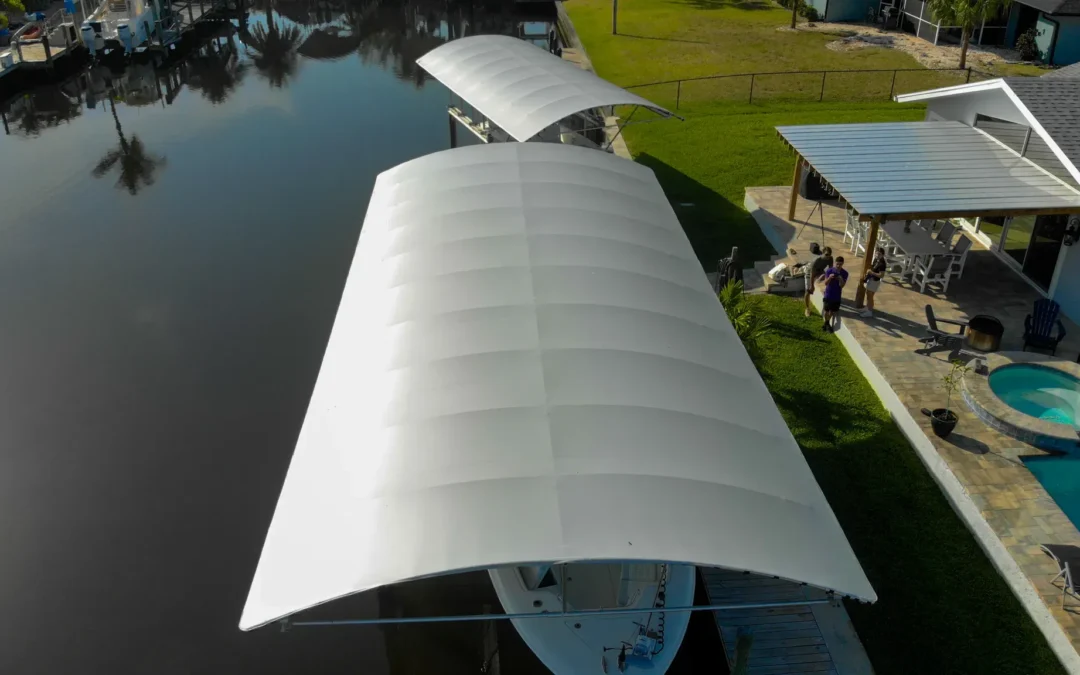
Living on the water in Southwest Florida means dealing with strong winds, and your boat lift canopy is the first thing to take the hit. A canopy that collapses or tears in a storm can leave your boat exposed to damage that costs thousands to repair. The good news is that wind resistance is not a matter of luck. It comes down to frame engineering, material selection, and how well those components work together under stress.
Request your free estimate from Coastline Boat Lift Covers to find the right wind-resistant canopy for your dock.
This guide walks you through the specific features that separate a wind-resistant boat lift canopy from one that will not survive a Florida storm season. You will learn how frame construction, baseplate count, rafter spacing, and fabric choice each contribute to wind performance, and how to evaluate these factors when shopping for a new canopy system.
What Makes a Boat Lift Canopy Wind-Resistant?
A wind-resistant boat lift canopy is a cover system engineered to maintain structural integrity and fabric tension during sustained high winds and sudden gusts. Wind resistance depends on three factors working together: a rigid frame that resists bending, multiple anchor points that distribute load evenly, and a tightly fitted fabric that does not catch wind like a sail.
Most canopy failures during storms happen because one of these three components is weak. A flexible frame allows the structure to rack side-to-side. Too few supports concentrate stress at single points until something gives. Loose fabric flaps in the wind, creating repeated force cycles that fatigue stitching and tear grommets. When all three elements are engineered for wind, the system handles conditions that would destroy a lower-quality setup.
In Southwest Florida, where sustained tropical storm winds can reach 60+ mph and hurricane gusts exceed 100 mph, these engineering details are not optional extras. They determine whether your canopy survives storm season or ends up wrapped around a neighbor’s dock.
I-Beam Frames vs. Round Tube: Why Construction Method Matters
The frame is the backbone of your canopy system, and the construction method determines how it performs under wind load. There are two main approaches: traditional round tube frames and I-beam frames.
Round tube frames are common across the industry because they are relatively inexpensive to manufacture and easy to bend into shape. The problem is their structural limitation: round tubes are equally strong (and equally weak) in all directions. Under wind load, they tend to flex uniformly, which means the entire frame can deform when hit with strong gusts from any angle.
I-beam frames take a different approach. The “I” cross-section concentrates material where it matters most, along the top and bottom flanges, creating superior resistance to bending. This is the same structural principle used in bridges and buildings. Under wind load, an I-beam frame bends rather than buckling. That distinction is important: bending means the frame flexes under stress and returns to its original shape, while buckling means permanent deformation or collapse.
| Feature | Round Tube Frame | I-Beam Frame |
|---|---|---|
| Bending resistance | Equal in all directions, moderate overall | High resistance along primary load axis |
| Failure mode under wind | Buckling and permanent deformation | Controlled bending, returns to shape |
| Weight | Lighter | Slightly heavier |
| Fabric sagging over time | More likely as frame flexes | Less likely due to rigidity |
| Long-term durability | Good for moderate conditions | Built for coastal and high-wind areas |
| Best for | Protected docks, low-wind areas | Exposed docks, coastal Florida, storm zones |
Bottom line: If your dock is exposed to open water or sits in a coastal area like Southwest Florida, an I-beam frame gives you meaningfully better wind resistance than a round tube alternative.
How Many Supports Does Your Canopy Need?
The number of vertical supports (also called uprights or baseplates) directly affects how well your canopy handles wind. Each support is an anchor point that transfers wind load from the frame down into the boat lift structure. More anchor points mean the total wind force gets divided across more connection points, reducing stress at each one.
Many canopy companies use 2 or 3 uprights per side. This keeps manufacturing costs low but creates a structural weakness. With only 2 supports per side, the span between them is long, and the unsupported middle section of the frame becomes a lever arm that amplifies wind force at the connection points. During high winds, these concentrated stress points are where failures happen: bolts shear, welds crack, or the frame pulls away from the lift.
Coastline Boat Lift Covers uses 4 uprights per side as the standard configuration. This design cuts the unsupported span between each support roughly in half compared to a 2-support setup. The result is a more rigid structure that distributes wind load across 8 total connection points instead of 4 or 6. Think of it like a table: a table with 4 legs is more stable than one with 2, and one with 8 anchor points handles lateral force even better.
Get a free estimate to see how a 4-support canopy system fits your specific boat lift configuration.
Does Rafter Spacing Affect Wind Performance?
Yes, and it is one of the most overlooked factors in canopy wind resistance. Rafters are the horizontal cross-members that span the top of your canopy frame. The fabric is stretched over these rafters, and the spacing between them determines how much unsupported fabric area is exposed to wind.
When rafters are spaced far apart, large sections of fabric span the gaps with no support underneath. Wind pushes up on these unsupported fabric panels, creating a ballooning effect. Each gust lifts the fabric, stretches it, and then drops it. Over time, this repeated stress cycle loosens the fabric, weakens stitching, and can eventually tear the canopy from the frame.
Closer rafter spacing reduces the unsupported fabric area between each rafter. The fabric stays flatter and tauter because each panel has less room to balloon. This achieves two things: it reduces the total wind uplift force on the canopy (less surface area acting as a sail) and it distributes the remaining force more evenly across the frame.
There is no universal standard for rafter spacing in the boat lift canopy industry. When evaluating options, ask the manufacturer what their standard rafter spacing is and whether they offer closer spacing for high-wind applications. A difference of a few inches between rafters can translate to a significant improvement in how the canopy handles a 50 mph gust.
Choosing Fabric That Holds Up in High Winds
The fabric is the component that actually takes the direct force of the wind, so its strength, stretch characteristics, and attachment method all matter for wind resistance.
What to Look for in Wind-Resistant Fabric
- Tear strength: This measures how much force it takes to propagate a tear once one starts. Marine-grade vinyl-laminated polyester fabrics like Patio 500 are engineered for high tear strength, which means a small nick from debris will not turn into a full rip during a storm.
- UV resistance: Florida sun degrades fabric over time, making it brittle and weak. UV-resistant fabrics maintain their strength and flexibility through years of sun exposure, so they perform better during storms even after several seasons of use.
- Dimensional stability: Fabric that stretches under load creates slack, which leads to flapping. Look for fabrics that hold their shape when pulled tight over the frame.
- Mildew and moisture resistance: Trapped moisture promotes mildew growth, which breaks down fabric fibers over time. A waterproof, mildew-resistant fabric stays stronger longer.
Thread Matters Too
The stitching that holds your canopy together is only as strong as the thread used. Standard polyester thread degrades in UV exposure and salt air. GORE TENARA thread, made from expanded PTFE (the same material in high-performance outdoor gear), resists UV, salt, rain, and temperature extremes without losing strength. When a 70 mph gust hits your canopy, you want every seam holding firm. Thread failure is one of the most common causes of canopy blowouts during storms.
How Florida Weather Puts Canopies to the Test
Southwest Florida is one of the most demanding environments for boat lift canopies in the entire country. Understanding the specific weather threats helps you make better decisions about wind resistance features.
- Hurricane season (June 1 to November 30): Six months of potential tropical storms and hurricanes with sustained winds that can exceed 100 mph. Even tropical depressions produce wind and rain that test canopy systems.
- Afternoon thunderstorms (May to October): Florida’s daily summer storms produce sudden wind gusts that can reach 60 mph with little warning. These short-duration, high-intensity events stress canopies differently than sustained hurricane winds.
- Salt air corrosion: Constant salt exposure weakens metal fasteners and corrodes frame joints, reducing the structural integrity of your canopy over time. Marine-grade materials with corrosion-resistant coatings are not a luxury here; they are a basic requirement.
- UV exposure: Florida ranks among the highest UV index states in the country. Year-round sun breaks down fabric and thread that is not specifically rated for extended UV exposure.
According to the National Oceanic and Atmospheric Administration (NOAA), Florida has been hit by more hurricanes than any other U.S. state, with Southwest Florida averaging a tropical storm or hurricane impact every 2 to 3 years. Your canopy needs to be ready for that reality.
What Is a Hurricane Removal Protocol?
A hurricane removal protocol is a pre-arranged service where your canopy provider removes your canopy before a storm arrives and reinstalls it after the storm passes. Even the strongest canopy should be removed ahead of a major hurricane. No residential boat lift canopy is rated to withstand Category 3+ sustained winds, and leaving it in place risks damage to the canopy, the frame, the boat lift, and the boat itself.
Coastline Boat Lift Covers operates a dedicated Hurricane Protocol program that allows customers to pre-book removal before storm season begins. Pre-booking is important for two reasons: removal crews get overwhelmed with last-minute requests once a storm is named, and last-minute removals often come with emergency surcharges. Booking early locks in standard pricing and guarantees your spot on the removal schedule.
When evaluating canopy providers, ask these questions about their hurricane protocol:
- Do they offer pre-season removal booking?
- What is the turnaround time for reinstallation after a storm passes?
- Do they store the canopy components during the storm, or is that your responsibility?
- What happens if a storm is named before your scheduled removal date?
- Are there emergency surcharges for last-minute requests?
Reserve your spot in Coastline’s Hurricane Protocol program before storm season starts.
A Checklist for Evaluating Wind Resistance
Use this checklist when comparing boat lift canopy providers. Not every company will publish this information on their website, so you may need to ask directly.
- Frame construction: Is the frame built with I-beam or round tube construction? I-beam is stronger for wind resistance.
- Number of uprights: How many vertical supports per side? 4 per side is the gold standard; 2-3 is standard but less wind-resistant.
- Rafter spacing: What is the distance between horizontal rafters? Closer spacing means better fabric support and less wind uplift.
- Fabric type: Is the fabric marine-grade with high tear strength and UV resistance? Ask for the specific product name.
- Thread type: What thread is used for stitching? GORE TENARA or equivalent UV-resistant thread is preferred.
- Custom fit: Is the canopy made to your exact measurements, or is it a stock size? Custom fit means less slack, which means less wind catch.
- Warranty: What are the frame and fabric warranty terms? A 10-year frame warranty and 5-year canopy warranty indicate the manufacturer stands behind their product’s durability.
- Hurricane protocol: Does the provider offer pre-season removal and reinstallation? This service protects your investment during the storms no canopy can handle.
Frequently Asked Questions
What wind speed can a boat lift canopy handle?
Most quality boat lift canopies are designed to handle sustained winds of 50 to 70 mph when properly installed and tensioned. Canopies with I-beam frames, 4 supports per side, and marine-grade fabric perform at the higher end of that range. For winds above 75 mph (hurricane-force), removal is recommended to protect the canopy and the boat lift structure.
Is an I-beam canopy frame worth the extra cost?
For boat owners in coastal Florida, yes. The difference in cost between I-beam and round tube frames is modest compared to the cost of replacing a damaged canopy, repairing your frame, or fixing storm damage to your boat. I-beam frames also experience less fabric sagging over time, which extends the life of your canopy cover.
How often should I replace my boat lift canopy in Florida?
A high-quality marine-grade canopy typically lasts 7 to 12 years in Florida with proper maintenance. Factors that shorten lifespan include direct exposure to prevailing winds, lack of hurricane removal, and choosing lower-quality fabric. Check your canopy annually for signs of wear like fraying seams, faded fabric, or rust on frame connections.
Can I add wind resistance to an existing canopy setup?
Some upgrades are possible without a full replacement. You can replace worn fabric with a higher-grade material, upgrade thread to GORE TENARA, or add tie-down straps for extra security during storms. However, changing the frame construction from round tube to I-beam or adding more uprights typically requires replacing the frame entirely. A professional assessment can help you determine which upgrades make sense for your current setup.
Should I remove my canopy for every storm warning?
Not necessarily. Tropical storm watches and minor wind events usually do not require removal if your canopy is in good condition and properly installed. Hurricane warnings with projected sustained winds above 75 mph are when removal becomes important. A pre-booked hurricane protocol gives you a clear plan for when to act without scrambling at the last minute.
Protect Your Boat with the Right Canopy
Choosing a wind-resistant boat lift canopy comes down to engineering details: I-beam construction for frame rigidity, 4 uprights per side for load distribution, closer rafter spacing for fabric support, and marine-grade materials that hold up through years of Florida weather. Pair those features with a hurricane removal protocol, and you have a canopy system built to protect your boat through everything Southwest Florida can deliver.
Coastline Boat Lift Covers manufactures every canopy frame and cover at their Fort Myers facility, using I-beam construction, 4 supports per side, Patio 500 marine-grade fabric, and GORE TENARA thread as standard. Every system is custom-measured and installed by trained crews who understand the demands of Florida’s coastal environment.
Request your free estimate today and get a canopy built to handle Florida’s toughest conditions.