
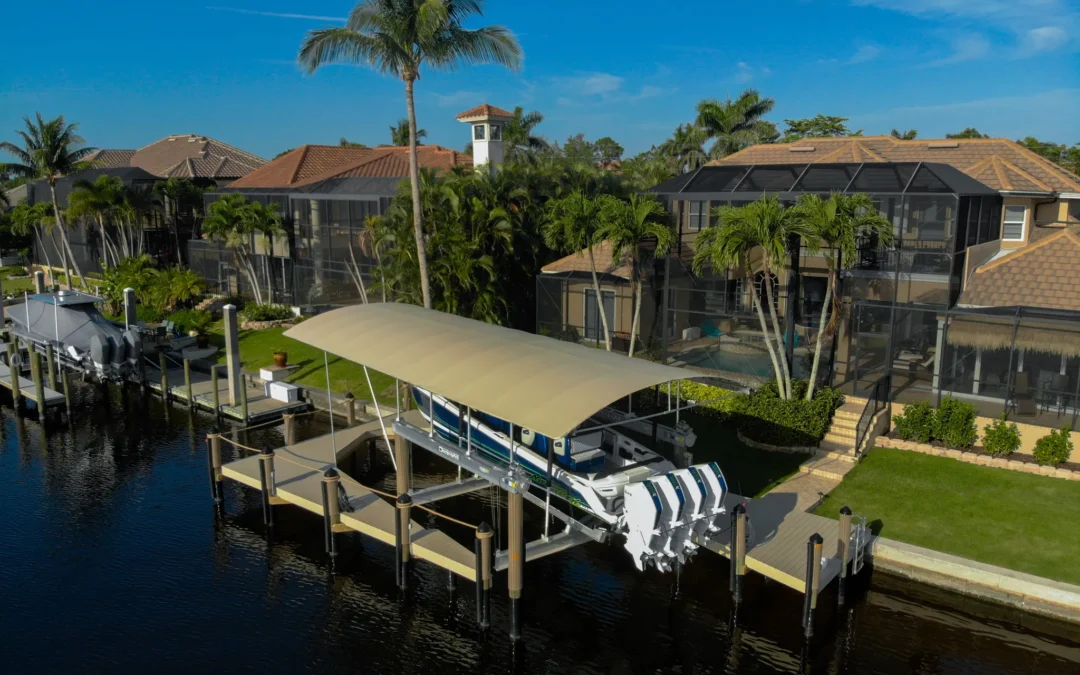
You just bought a new boat lift, or maybe you have had one for years, and now you want to add a canopy. The first question that comes up: will a canopy actually fit my specific lift? The answer depends on your lift type, the brand, your dock layout, and a few measurements most boat owners overlook.
Request your free estimate from Coastline Boat Lift Covers and we will measure your lift, confirm compatibility, and recommend the right canopy system for your setup.
This guide walks through every major lift type, explains what affects compatibility, and shows you exactly what to check before ordering a canopy. Whether you have an elevator lift tucked against a seawall or a four-post cradle lift on open pilings, there is a canopy solution that works. The key is matching the right frame style and size to your specific configuration.
What Determines Boat Lift Canopy Compatibility?
Canopy compatibility is not just about picking a size off a chart. Several factors work together to determine whether a canopy system will fit your boat lift correctly and hold up over time.
Lift type is the starting point. Elevator lifts, cradle lifts, floating lifts, and freestanding lifts each have different structural designs. The number of pilings, the position of the beams, and how the lift raises your boat all affect where and how a canopy frame attaches.
Piling spacing and height matter just as much as the lift itself. A canopy frame needs to mount to pilings or a support structure with the right distance between them. If your pilings are too close together, a standard frame will not fit. If they are too far apart, the canopy fabric will not maintain proper tension.
Boat size and clearance play a role too. The canopy needs enough vertical clearance above the boat, including any T-tops, towers, or radar arches. A canopy that is too low will press against your boat’s superstructure, and one that is too high loses its ability to provide shade and weather protection at the dock level.
Other factors include:
- Dock orientation: The direction your dock faces affects wind exposure, which influences the ideal frame style
- HOA or marina restrictions: Some communities limit canopy height, color, or overhang distance
- Existing hardware: Older lifts may need adapter brackets or reinforced mounting points
- Local building codes: In Southwest Florida, wind load requirements dictate minimum frame strength standards
A professional measurement accounts for all of these variables. Trying to order a canopy based on general lift dimensions alone often leads to fit problems, wasted money, or a canopy that fails in the first strong storm.
Canopy Options for Elevator Boat Lifts
Elevator lifts use vertical tracks mounted to a seawall or pilings along one side. The boat rides up and down on a platform or cradle attached to those tracks. Because the mechanical components sit along the sides, canopy frames need to work around the lift’s vertical rails and motor housing.
The good news is that elevator lifts are some of the most canopy-friendly designs available. The vertical track system typically leaves the area above the boat open and clear, giving you plenty of room for a canopy frame.
What to watch for with elevator lifts:
- The canopy frame must clear the lift motor and any top-mounted pulleys
- Side clearance matters because the vertical tracks extend above the waterline
- Many elevator lifts are installed in narrow canals or along seawalls where wind loads are concentrated, so a stronger frame design (like an I-beam frame) helps resist lateral forces
- The mounting points usually attach to the same pilings that support the lift tracks
For elevator lifts in tight canal settings, the Antigua frame style works well because it provides direct coverage without extra overhang, keeping everything within your dock footprint.
Canopy Options for Cradle Boat Lifts
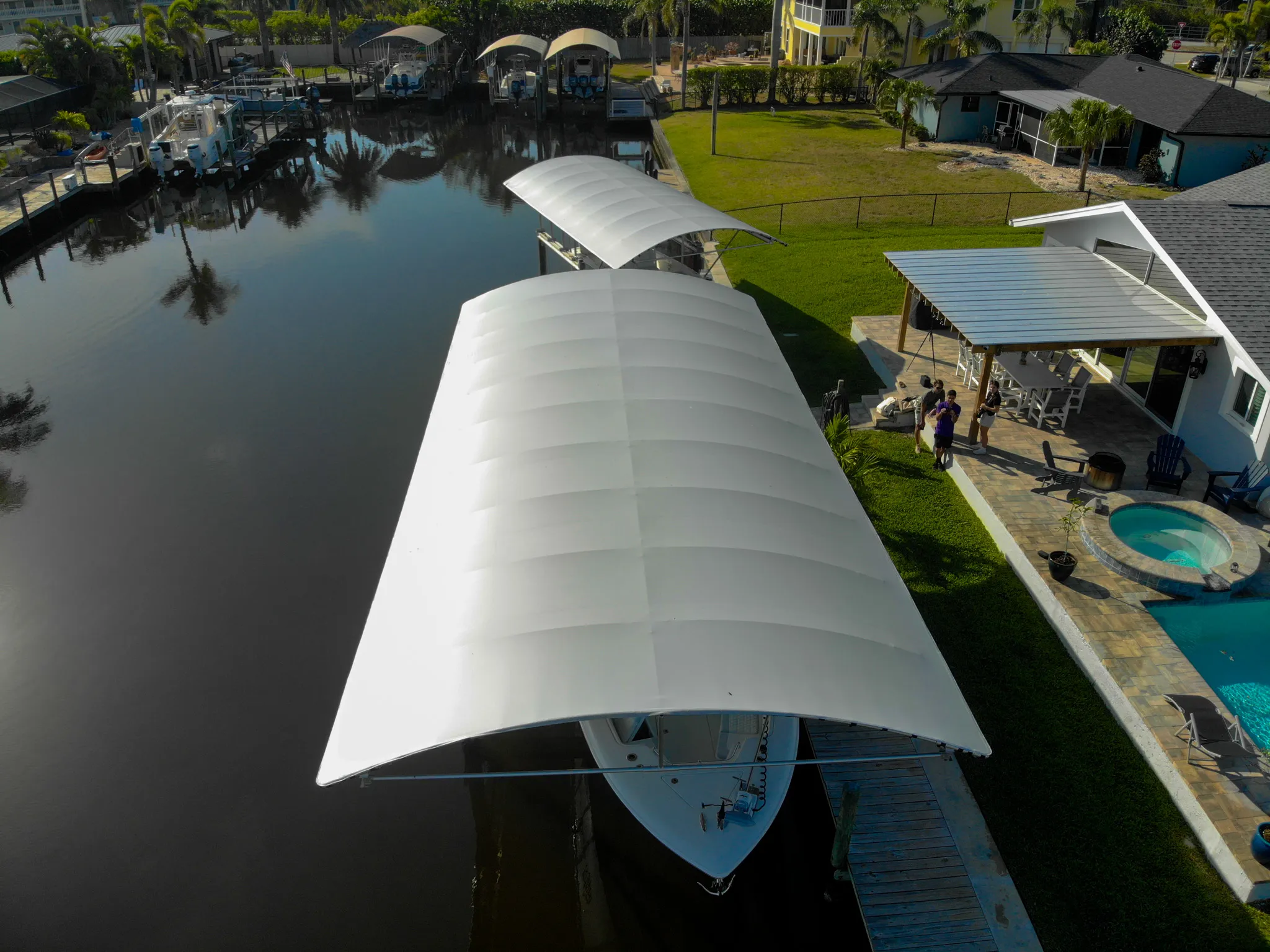
Cradle lifts are the most common type in Southwest Florida. They use four vertical pilings with cross beams that support a cradle or bunks underneath your boat. The boat rests in this cradle and gets lifted straight up out of the water.
Because cradle lifts rely on a four-post structure, they naturally create an ideal framework for canopy installation. The four pilings serve double duty as both lift supports and canopy mounting points. This makes cradle lifts the easiest type to fit with a canopy.
Compatibility considerations for cradle lifts:
- Piling height above the lift determines maximum canopy clearance
- The distance between pilings sets your canopy width and length
- Cross-beam position can affect where the canopy frame attaches
- Heavier boats on larger cradle lifts may need reinforced pilings to handle the added wind load from a canopy
Get a free estimate to find out which frame style fits your cradle lift.
All four of Coastline’s frame styles, the Dominica with I-beam, Cayman, Barbados, and Antigua, are compatible with standard cradle lifts. The best choice depends on your specific needs. The Dominica with I-beam offers maximum wind resistance for exposed locations. The Cayman is the most versatile option, working well for boats without hard tops or in no-build zones. The Barbados provides a traditional V-shape with 12 to 30 inches of overhang for extended dock shade.
Can You Put a Canopy on a Floating Boat Lift?
Floating boat lifts sit on the water’s surface and use air or water displacement to raise and lower your boat. They are popular in areas with fluctuating water levels or where permanent pilings are not allowed.
Adding a canopy to a floating lift is possible, but it requires a different approach than a standard piling-mounted system. Because the lift itself moves with the water, the canopy typically needs to mount to fixed dock pilings rather than the lift structure. This creates a stationary overhead cover while the lift floats freely underneath.
Key compatibility factors for floating lifts:
- You need existing pilings or a fixed structure near the lift to mount the canopy frame
- The canopy must be high enough to allow the lift and boat to rise and fall with tidal changes
- Wind exposure is often greater with floating lifts since they are usually in more open water
- Frame style selection should prioritize wind resistance because there is less sheltering from surrounding dock structures
If your floating lift sits between dock pilings, a canopy is straightforward. If the lift is moored in open water without nearby pilings, a canopy installation becomes more complex and may require adding dedicated support posts.
Freestanding Lifts and Canopy Compatibility
Freestanding boat lifts are self-contained units that do not rely on dock pilings. They sit on the waterway bottom and support the boat independently. These lifts are common in areas where dock construction is restricted or where boat owners want a portable lifting solution.
Canopy compatibility with freestanding lifts depends on what structural support exists nearby. Because the lift itself is not designed to bear the additional wind load of a canopy, you need separate mounting points.
Options for adding a canopy to a freestanding lift:
- Mount the canopy frame to nearby dock pilings if available
- Install dedicated canopy pilings around the lift
- Use a freestanding canopy structure independent of the lift
In each case, professional measurement is critical. The canopy must be positioned so it does not interfere with the lift’s operation while still providing adequate coverage for your boat.
Brand Compatibility: Hewitt, ShoreStation, ShoreMaster, and More
Boat owners often ask whether their specific lift brand affects canopy compatibility. The short answer: a custom canopy works with virtually any lift brand because the frame is built to match your exact piling configuration, not a specific manufacturer’s specs.
Here is how compatibility works with popular brands:
| Lift Brand | Common Lift Types | Canopy Compatibility |
|---|---|---|
| Hewitt | Cradle, vertical | Compatible with all frame styles; standard piling spacing |
| ShoreStation | Cradle, elevator | Compatible; may need clearance check for top-mount motors |
| ShoreMaster | Cradle, hydraulic | Compatible; hydraulic components require overhead clearance |
| Hurricane | Cradle, beamless | Compatible; beamless designs offer maximum frame flexibility |
| Golden Boat Lifts | Cradle, elevator | Compatible; common in SWFL with standard piling layouts |
| HydroHoist | Floating | Compatible with fixed piling-mounted canopy frames |
The reason custom canopies work across brands is that the canopy frame attaches to the pilings, not to the lift hardware itself. Your lift brand determines the lift’s footprint and mechanical layout, but the canopy is a separate structure that sits above it.
That said, some brand-specific details matter during measurement:
- Motor position: Top-mounted motors (common on ShoreStation and some ShoreMaster models) need extra clearance above the lift
- Beam layout: The position of cross beams on brands like Hewitt can affect where the canopy frame’s uprights align
- Lift capacity ratings: Heavier-duty lifts often use wider piling spacing, which affects canopy size
A professional on-site measurement captures all of these brand-specific details so the canopy fits perfectly regardless of what lift brand you have. Coastline services all major lift brands and types across Southwest Florida.
How to Measure Your Boat Lift for a Canopy
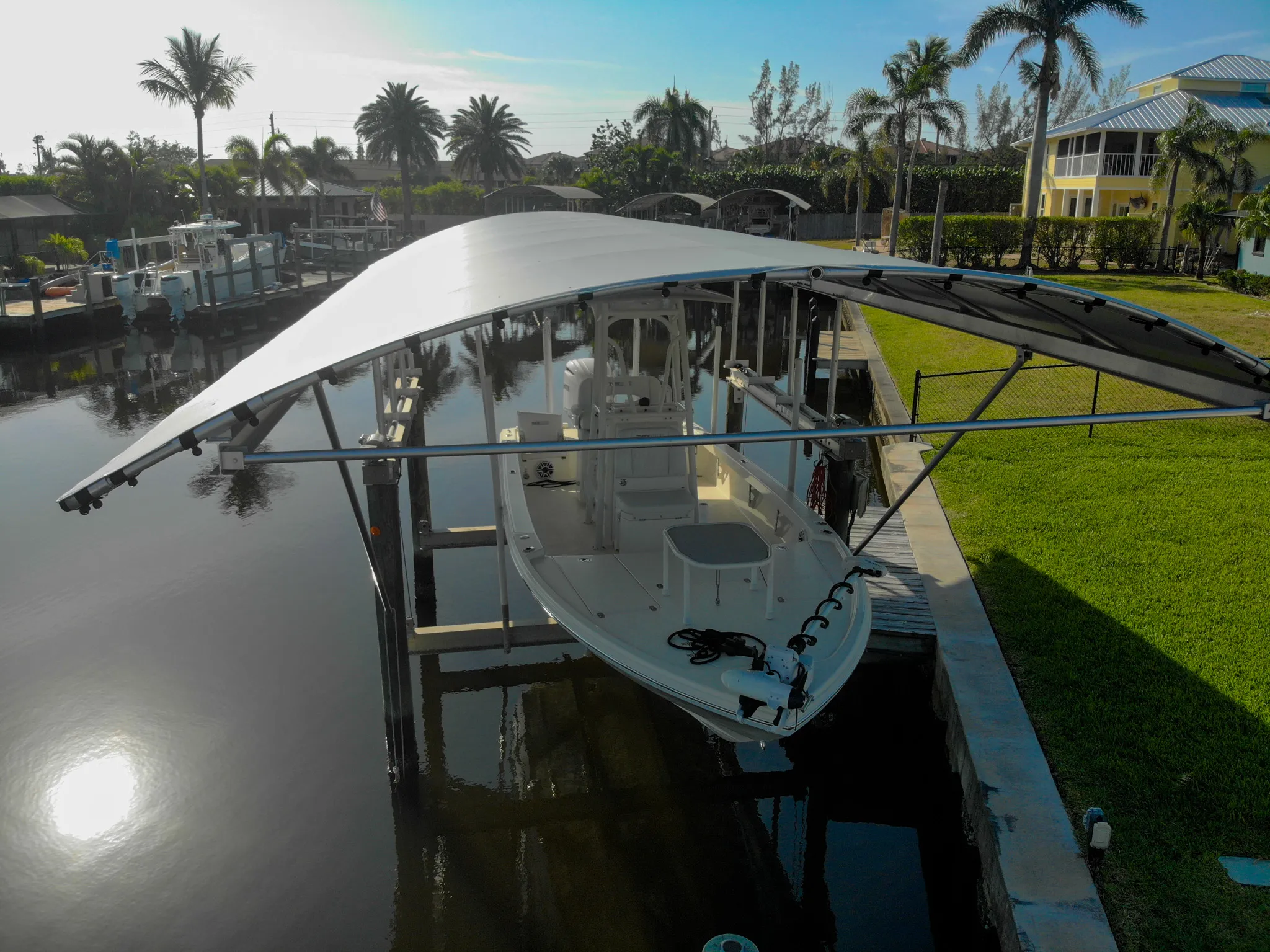
While a professional measurement is always recommended, understanding the basic dimensions helps you prepare for a consultation and gives you confidence that a canopy will work with your setup.
Measurements you need:
- Piling-to-piling width: Measure the distance between the front two pilings (or the side-to-side distance) at the point where the canopy frame would attach
- Piling-to-piling length: Measure front to back between the pilings
- Piling height above the dock: Measure from the dock surface to the top of each piling, as they are not always equal
- Boat height at highest point: Measure from the lift bunks to the top of any T-tops, towers, antennas, or arch structures on your boat
- Clearance above boat: Subtract boat height from piling height to determine available canopy space (you need at least 12 inches of clearance)
Take photos of your lift from multiple angles, including close-ups of the piling tops and any existing hardware. These help the canopy manufacturer identify potential mounting challenges before the on-site visit.
Schedule your free professional measurement and Coastline’s team will handle every detail.
What If My Lift Is Not Standard?
Not every boat lift fits neatly into a category. Older lifts, modified lifts, and custom dock configurations can all create unusual situations. Here are the most common non-standard scenarios boat owners run into:
Uneven pilings: Pilings that have shifted or settled over time may sit at different heights or angles. A custom canopy frame can be built with adjustable mounting hardware to compensate, but the pilings need to be structurally sound.
Extra-wide or narrow piling spacing: Standard cradle lifts use piling spacing between 8 and 16 feet, but some configurations fall outside that range. Custom fabrication handles non-standard widths, though extreme dimensions may require a specific frame style for structural integrity.
Mixed lift and dock systems: If your boat lift was added to an existing dock, the pilings supporting the lift may be different from the dock pilings. The canopy frame can span both, but the measurement process needs to account for any misalignment.
No-build zones and permit restrictions: Some Florida waterfront communities restrict overhead structures. In these cases, the Cayman frame style from Coastline is designed specifically for no-build zone compliance, providing full protection while meeting local regulations.
If you are unsure about your lift’s configuration, a photo and a phone call to a canopy specialist can usually determine compatibility within minutes.
Why Custom-Fit Canopies Outperform Universal Covers
Universal or “one-size-fits-most” canopy covers are available from some manufacturers, but they come with trade-offs that matter in Florida’s climate.
A universal cover might work in calm, freshwater environments where wind and UV exposure are moderate. In Southwest Florida, where sustained winds, salt air, and intense sun are constant factors, a poorly fitted canopy creates problems:
- Fabric pooling: Loose areas collect rainwater and debris, adding weight that stresses the frame
- Wind vulnerability: Gaps between the fabric and frame create entry points for wind, which can tear the cover loose or damage the frame
- Reduced UV protection: Sagging fabric does not provide consistent shade coverage, leaving parts of your boat exposed
- Shorter lifespan: Constant flapping and friction from a poor fit accelerates fabric wear
A custom-fit canopy, built to your exact piling dimensions and tensioned properly during installation, eliminates these problems. Coastline uses Patio 500 marine-grade vinyl-laminated polyester fabric that performs best when stretched to proper tension on a precisely fitted frame. Combined with GORE TENARA thread and a solid I-beam frame construction, the result is a system that handles Florida’s toughest conditions.
Coastline backs every system with a 10-year frame warranty, 5-year canopy warranty, and lifetime stitching guarantee. That level of coverage is only possible because each canopy is built to fit one specific lift.
Frequently Asked Questions
Will any canopy fit any boat lift?
Not out of the box. Every boat lift has a unique combination of piling spacing, height, and mechanical layout. A custom canopy built to your lift’s exact measurements is the only way to guarantee a proper fit, full coverage, and long-term durability. Universal covers exist, but they do not hold up well in Florida’s wind and salt air conditions.
Can I add a canopy to an older boat lift?
Yes, in most cases. If the pilings are structurally sound and spaced within standard ranges (typically 8 to 16 feet), a canopy frame can be installed on an older lift. A professional inspection checks piling condition, alignment, and load-bearing capacity before recommending a frame style.
Do I need to remove my canopy during hurricane season?
Removing your canopy before a storm is the safest option. Coastline offers a Hurricane Protocol service that handles pre-season removal, secure storage, and reinstallation after the storm passes. Pre-booking locks in standard pricing and reserves your spot before the rush.
How long does it take to get a canopy installed after ordering?
Typical turnaround from measurement to installation is a few weeks, depending on the frame style and current demand. Custom fabrication happens at Coastline’s Fort Myers facility, so local customers benefit from shorter lead times compared to out-of-state manufacturers.
What frame style is best for my lift type?
It depends on your specific setup. The Dominica with I-beam is the strongest option for high-wind areas. The Cayman works best for versatile applications and no-build zones. The Barbados provides extended overhang for extra dock shade. The Antigua fits tight spaces where you need direct coverage. A free estimate includes a frame style recommendation based on your lift, dock, and local conditions.
Can I keep my canopy if I switch boat lift brands?
Usually, yes. Because the canopy frame mounts to your pilings rather than the lift hardware, changing your lift brand typically does not require a new canopy. However, if the new lift changes the piling spacing or requires different piling heights, the canopy frame may need adjustment. Check with your canopy provider before switching lifts.