
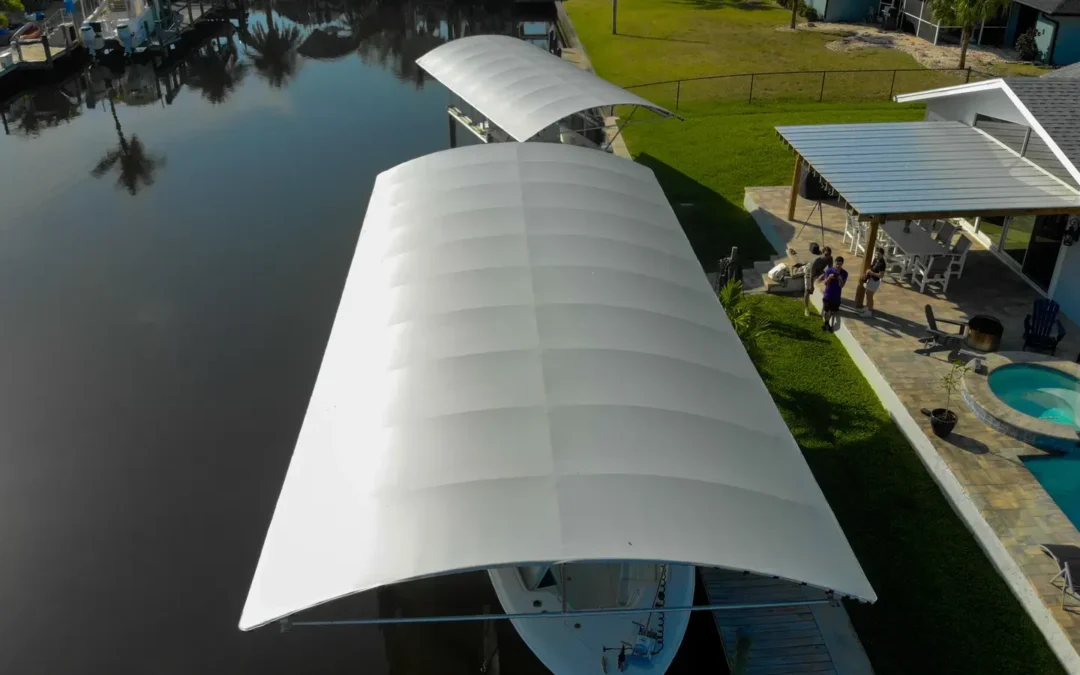
A wind damage boat lift canopy problem usually starts small: one stretched bungee, one loose corner, one fabric panel that flaps harder than the rest. Left alone, those small issues can turn into torn fabric, bent frame members, damaged stitching, or a canopy that exposes your boat right when you need protection most. For Southwest Florida boat owners, preventing wind damage is not just storm prep. It is part of keeping a canopy safe, tight, and useful through everyday sea breezes, afternoon thunderstorms, tropical systems, and hurricane season.
Request your free estimate from Coastline Boat Lift Covers if your canopy has storm damage, loose fabric, missing bungees, or a frame that needs professional inspection.
This guide explains the most common types of wind damage to boat lift canopies, how to reduce the risk before the next blow, what repairs are realistic, when replacement is the better call, and what to document if you plan to contact your insurance carrier.
What Does Wind Damage to a Boat Lift Canopy Look Like?
Wind damage can affect the fabric, the attachment points, or the frame itself. The visible tear is often only the final symptom. The real problem may be uneven tension, worn hardware, or a frame that has been flexing under load for months.
Common signs of wind damage include:
- Torn canopy fabric: Rips often begin near corners, seams, bungee holes, or high-stress edges.
- Stretched fabric: A cover that used to fit tightly may begin to sag or flap after repeated wind events.
- Broken or missing bungees: Once a few bungees fail, nearby attachment points carry extra load and fail faster.
- Loose corners: Corners that lift in gusts can let the canopy act like a sail.
- Seam separation: Stitching can weaken from UV exposure, salt air, and repeated movement.
- Bent rafters or bows: Frame movement can change the fabric tension and create low spots.
- Shifted uprights or baseplates: The canopy may look out of square or lean toward one side.
- Noisy flapping: A canopy that snaps loudly in ordinary wind is usually too loose or unevenly attached.
If you notice any of these signs, do not wait for the next storm to test the system. Wind damage tends to compound. Loose fabric creates more movement, more movement stresses the bungees and seams, and the weakened canopy becomes easier for the next gust to grab.
Why Boat Lift Canopies Fail in High Wind
A boat lift canopy is designed to shed sun and rain every day, but wind adds a different kind of force. Wind pushes, lifts, twists, and pulses. The canopy has to transfer those loads from fabric to bungees, from bungees to frame, and from frame to supports. If any part of that chain is weak, the system can fail.
Loose Fabric Turns Into a Sail
The tighter and more evenly fitted the canopy fabric is, the less opportunity wind has to get underneath it. When the fabric is loose, gusts can lift the cover, snap it back down, and repeat that cycle hundreds of times during one storm. That movement fatigues stitching, stretches bungee holes, and can tear fabric at the corners.
Old Bungees Stop Holding Tension
Bungees are small parts with a big job. They keep the fabric tensioned and help distribute force across the frame. In Florida heat and salt air, bungees can dry out, stretch, crack, or lose elasticity. When they stop rebounding, the fabric loosens. When one breaks, the neighboring bungees take on extra stress.
Frame Flex Creates Uneven Load
Wind does not hit every part of a canopy evenly. A weaker or misaligned frame may flex more on one side, which pulls the fabric out of balance. Over time, that can create stress points, sagging, and premature fabric damage. This is why frame design matters when choosing a wind-resistant boat lift canopy.
Storm Prep Happens Too Late
Many canopy failures happen because the system was not inspected until a named storm was already in the forecast. By then, service schedules fill fast, supplies are harder to secure, and minor maintenance can turn into emergency work. Coastline’s Hurricane Protocol exists for this reason: early planning helps reduce rushed decisions and last-minute risk.
How to Prevent Wind Damage Before Storm Season
The best way to handle wind damage is to stop small weaknesses before wind finds them. A pre-season inspection takes less time than a major repair and can help you avoid exposing your boat during the worst weather of the year.
1. Inspect the Fabric for Weak Points
Walk the full perimeter of the canopy and look closely at the corners, seams, and attachment points. These areas carry the most stress during wind. Look for fraying, thinning fabric, elongated bungee holes, seam separation, mildew-softened areas, and spots where the fabric looks stretched or shiny from repeated movement.
If the cover has multiple weak points, patching one tear may not solve the bigger issue. A professional inspection can help determine whether the fabric still has enough strength to keep using safely.
2. Replace Worn Bungees as a Set
Replacing one broken bungee is a temporary fix. If one has failed from age, the others are usually close behind. Replacing the full set restores even tension and reduces the chance that one new bungee carries a different load than several old ones.
Pay attention to spacing and tension. Bungees that are too loose allow lift. Bungees that are overtightened can strain fabric holes and seams. The goal is balanced, consistent hold across the whole canopy.
3. Keep the Canopy Tight and Even
After bungee replacement, look at the canopy from several angles. The fabric should sit evenly across the frame without deep dips, loose corners, or one side pulling harder than the other. Uneven tension often points to a frame alignment issue, not just a fabric issue.
For more troubleshooting, see Coastline’s guide to common boat lift canopy problems.
4. Check the Frame, Baseplates, and Uprights
Wind damage prevention is not only about the cover. The frame has to stay square and stable. Inspect the uprights, rafters, connection points, baseplates, and any visible fasteners. Look for movement, corrosion, cracks, bent members, missing hardware, or unusual gaps.
If the frame looks shifted or twisted, stop treating it as a fabric-only problem. A canopy cover cannot perform correctly on a compromised frame.
5. Choose a Stronger Frame Design When Replacing
If your current canopy has repeated wind problems, frame design may be part of the issue. Coastline offers custom frame styles with optional I-beam reinforcement, including the Dominica w/ I-Beam, built for maximum wind resistance. I-beam construction helps the frame bend under stress instead of buckling, which is why it is used in many heavy-duty structural applications.
Coastline also uses four uprights per side on many systems instead of the industry-standard two or three. More support points help spread loads and reduce stress concentration. You can compare options on the boat lift canopy frame styles page.
Should You Remove a Boat Lift Canopy Before a Hurricane?
In many cases, yes. If a hurricane or major tropical system is approaching, removing the fabric cover can reduce the chance that the canopy catches wind and damages the frame, dock, lift, or nearby property. The right decision depends on the storm forecast, your canopy style, the condition of the fabric, local exposure, and how early you can schedule removal.
Reserve your Hurricane Protocol spot before a named storm if you want professional canopy removal and reinstallation support.
Waiting until a named storm is on the way creates two problems. First, removal requests spike and service slots fill quickly. Second, emergency work may cost more than pre-booked service. Coastline’s hurricane removal program is designed to help boat owners plan before the forecast becomes urgent.
Repair Options for Wind-Damaged Boat Lift Canopies
Not every wind-damaged canopy needs to be replaced. Some damage is repairable if the fabric, frame, and attachment points are still structurally sound. The key is knowing whether the repair will restore reliable protection or simply hide a larger problem.
Bungee Replacement
Bungee replacement is often the first repair when the fabric is sagging, flapping, or pulling unevenly. Fresh bungees can restore tension and reduce movement. This is most effective when the fabric itself is still in good shape and the frame remains square.
Small Fabric Repairs
Small tears may be repairable, especially if they are isolated and not located in a high-load corner. The repair method depends on the fabric type, tear location, and remaining fabric strength. A patch on old, brittle, or stretched material may not hold long.
Seam and Stitching Repair
If seams are opening, the canopy needs closer evaluation. Stitching failure can be caused by UV exposure, age, or repeated flapping. Coastline’s use of GORE TENARA thread and a lifetime stitching guarantee on qualifying covers is designed to reduce this common failure point, but older or non-Coastline covers may need repair or replacement.
Frame Adjustment or Repair
If a frame member is bent, shifted, or out of square, fabric repair alone will not solve the problem. A technician may need to adjust, reinforce, or replace frame components. Continuing to use a damaged frame can shorten the life of a new cover.
Replacement Cover
If the frame is sound but the fabric is worn out, a replacement cover may be the best value. Coastline can provide replacement covers for existing frames and can help determine whether your current setup is worth keeping.
When to Replace Instead of Repair
Repair makes sense when the damage is limited, the fabric still has strength, and the frame is square. Replacement makes more sense when the canopy has reached the point where repairs are likely to be short-lived.
Consider replacement if you see any of the following:
- Multiple tears across different sections of the fabric
- Fabric that feels brittle, thin, or permanently stretched
- Repeated bungee failures after recent replacement
- Large rips near corners, seams, or high-tension points
- Frame members that are bent, twisted, or no longer aligned
- Water pooling caused by structural sagging
- Storm damage that exposed the boat or pulled the cover partly loose
A repair that costs less today can be the wrong choice if it leaves your boat exposed next month. If the canopy has already failed in moderate wind, replacing it with a better-built system may be safer than chasing one patch after another.
What About Insurance for Wind Damage?
Insurance coverage for wind damage varies by policy, property type, and the cause of loss. A boat lift canopy may fall under homeowners insurance, dock coverage, marine coverage, a separate rider, or it may have exclusions. Because policies differ, the safest first step is to document the damage thoroughly and contact your insurance carrier before assuming coverage.
Before you call, gather:
- Photos of the whole canopy from several angles
- Close-up photos of tears, broken bungees, bent frame members, and shifted hardware
- The date and approximate time the damage occurred
- Weather details, if available
- Any maintenance or installation records you have
- A professional inspection or repair estimate, if requested by the carrier
Do not throw away damaged parts until you know whether the insurer wants to inspect them. If temporary action is needed to prevent further damage, take photos before and after the temporary fix.
How Coastline Helps Prevent and Repair Wind Damage
Coastline Boat Lift Covers manufactures and installs custom canopy systems in Southwest Florida, where wind, salt air, UV exposure, and hurricane season are part of everyday ownership. That local experience shapes the way each system is built and serviced.
Coastline can help with:
- Free estimates and professional measurement
- Custom boat lift canopy systems
- Replacement covers for existing frames
- Bungee replacement and maintenance
- Hurricane removal and reinstallation
- Frame style recommendations based on your dock, boat, and exposure
Every Coastline boat lift cover uses Patio 500 marine-grade vinyl-laminated polyester fabric, which is waterproof, UV-resistant, heat-reflective, tear resistant, mildew resistant, and easy to clean. Frame options can include I-beam reinforcement for added wind performance, and Coastline backs its work with a 10-year frame warranty, a 5-year canopy warranty, and a lifetime stitching guarantee on qualifying systems.
Wind Damage Prevention Checklist
Use this checklist before storm season and again after any major wind event:
- Inspect all corners, seams, and attachment points.
- Replace old or stretched bungees as a full set.
- Confirm the canopy fabric is tight and evenly tensioned.
- Look for sagging, water pooling, or noisy flapping.
- Check uprights, baseplates, rafters, and visible fasteners.
- Schedule repairs before the next forecasted storm.
- Pre-book hurricane removal instead of waiting for a named storm.
- Take photos after any wind event in case you need documentation.
FAQ: Wind Damage to Boat Lift Canopies
Can a torn boat lift canopy be repaired?
Yes, a torn boat lift canopy can sometimes be repaired if the tear is small, isolated, and the surrounding fabric is still strong. Large tears, corner tears, brittle fabric, or repeated failures usually point toward replacement.
How often should boat lift canopy bungees be replaced?
There is no single schedule for every dock, but bungees should be inspected at least before storm season and after major wind events. Replace them when they look cracked, stretched, loose, brittle, or uneven.
Is it better to remove the canopy before a hurricane?
For many Florida boat owners, removing the fabric before a hurricane is the safer choice because it reduces wind load on the canopy frame and dock. Schedule removal early because service demand rises quickly once a named storm is forecast.
Does a stronger frame prevent all wind damage?
No canopy system can guarantee protection from every storm, but a stronger frame, proper fabric tension, quality materials, and routine maintenance can greatly reduce the risk of wind-related failure.
Can Coastline repair non-Coastline canopies?
Coastline offers multi-brand servicing capabilities and can inspect many existing boat lift canopy systems. The team can recommend whether repair, replacement fabric, or a new custom system is the best path.
Get Your Canopy Ready Before the Next Blow
Wind damage is easier to prevent than to repair after a storm. If your canopy is loose, torn, sagging, missing bungees, or showing signs of frame movement, schedule an inspection before the next forecast puts pressure on every marine service crew in Southwest Florida.
Request your free estimate from Coastline Boat Lift Covers today, or reserve your Hurricane Protocol spot before storm season demand spikes.