
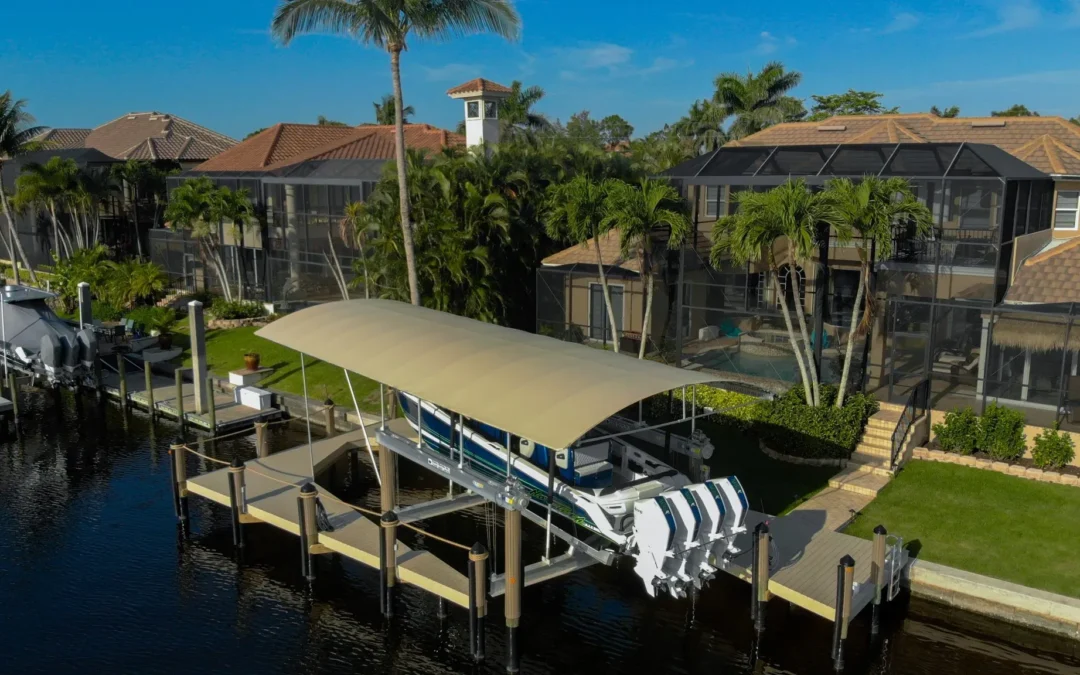
Best Custom Dock Covers for Florida Waterfront Homes
Florida waterfront living is exceptional, but the environment that makes it so appealing is also one of the most punishing on boats. Year-round UV exposure, salt air, humidity, afternoon storms, and hurricane season all combine to wear down unprotected vessels faster than owners expect. A quality custom dock cover changes that equation. The best custom dock covers in Florida are not off-the-shelf products — they are built around the specific boat, lift, dock, and property conditions of each waterfront home.
This guide breaks down what separates an average canopy from a genuinely great one, which materials hold up in Florida conditions, what frame construction actually matters, and how to evaluate providers before you commit.
Why Florida Waterfront Homes Need Custom Dock Covers
A generic, one-size-fits-most canopy can cover a boat. A custom dock cover is built to protect it — and there is a meaningful difference in Florida.
Southwest Florida alone has more than 900,000 registered boats. Most of those boats sit on lifts behind waterfront homes where they face:
- Intense UV radiation: Florida gets more sun than almost any other state. UV exposure fades gelcoat, cracks upholstery, damages electronics, and deteriorates vinyl over time.
- Salt air and humidity: Coastal properties see continuous salt air exposure that corrodes metal components and encourages mildew growth on fabric and upholstery.
- Afternoon storms: Florida’s daily storm pattern during summer can send rain sideways. A cover that doesn’t fit tightly around the specific boat profile allows water intrusion.
- Hurricane season: From June through November, Southwest Florida faces the real possibility of tropical storm or hurricane-force winds. A cover must either be engineered for high wind load or be part of a managed removal program.
- Tight dock layouts: Waterfront homes in Cape Coral, Fort Myers, Bonita Springs, and Marco Island often have constrained dock configurations — narrow side yards, neighboring structures, HOA restrictions, and seawall angles that a standard canopy cannot accommodate.
Custom fabrication addresses each of these factors directly. The cover is measured and built for the exact boat and lift configuration, which means better fit, better protection, and fewer long-term problems.
What Makes a Dock Cover “Custom”?
Not every cover advertised as “custom” is actually built to specification. Here is what true customization means in practice:
- On-site measurement: A trained technician measures the boat’s actual beam, height, console location, tower or hardtop configuration, and lift dimensions. No guessing, no standard size charts.
- Frame built to spec: The structural frame is fabricated to fit those measurements. This includes span, pitch, height, and upright placement.
- Fabric cut and sewn for the frame: The cover is not a pre-made sheet that gets stretched over a frame. It is cut, welded, or sewn to match the frame geometry and provide the intended coverage.
- Site-specific adjustments: Good custom fabricators account for dock layout, neighboring structures, wind exposure, and HOA requirements before finalizing the design.
A provider that only offers three or four standard sizes and calls it “custom” is selling something different from true custom fabrication. Ask specifically how they handle boats that fall outside standard size ranges.
The Best Frame Materials for Florida Dock Covers
Frame construction is the most important long-term variable in a dock cover’s performance. Florida’s coastal environment is hard on metal, and not all frame materials are equally suited for salt air, UV, and wind load.
I-Beam Construction vs. Round Tubing
Most dock cover frames use round aluminum tubing. It is inexpensive to source, easy to bend into standard shapes, and adequate for low-stress applications. In Florida’s coastal conditions, however, round tubing has meaningful limitations under wind load and over time.
I-beam construction — the same structural principle used in bridges and buildings — provides significantly greater rigidity per unit of weight. The geometry of an I-beam resists bending forces that round tubing transmits to the joints and connections. In a canopy system subjected to Florida wind events, that difference shows up in frame failures, bent uprights, and connection point stress over time.
Coastline Boat Lift Covers is currently the only Florida provider that specifically markets I-beam frame construction as a core engineering feature. Their frames also use four uprights per side, compared to the industry standard of two or three, which further distributes the load across the structure.
When comparing providers, ask directly: what is the frame cross-section, and how many uprights per side? Round tubing with two uprights per side is standard. I-beam construction with four uprights per side is a material upgrade.
Aluminum vs. Galvanized Steel
Most quality dock covers in Florida use aluminum frames because aluminum does not rust in salt air the way steel does. Galvanized steel offers strength but requires ongoing maintenance to prevent corrosion at any point where the galvanizing is scratched or damaged. For waterfront homes in salt air environments, aluminum or marine-grade aluminum alloy is the better long-term choice.
Want to discuss frame options for your dock? Contact Coastline for a free consultation and estimate.
Canopy Fabric: What Actually Holds Up in Florida
The fabric is what the sun, rain, and wind hit first. Not all marine fabrics perform the same way, and the differences become clear within a few years in Florida conditions.
Key properties to evaluate in any dock cover fabric:
- UV resistance: The fabric should block UV to protect what’s underneath and resist fading and degradation from sun exposure itself.
- Waterproofing: A vinyl laminate or waterproof coating prevents rain from soaking through to the boat.
- Tear resistance: Thin or low-denier fabrics can tear under wind load or at stress points around grommets and seams.
- Mildew resistance: Florida humidity is persistent. Fabrics that trap moisture or lack mildew inhibitors develop problems quickly.
- Heat reflectivity: A cover that reflects heat keeps the cockpit significantly cooler, which protects upholstery and electronics and makes the boat more comfortable to board.
Patio 500(r) by Trivantage is a vinyl-laminated polyester fabric that meets all of these criteria. It is waterproof, UV-resistant, heat-reflective, tear and mildew resistant, and available in 30 colors to coordinate with a home or HOA requirements. Coastline Boat Lift Covers uses Patio 500(r) as their standard fabric on all canopy systems.
Equally important is the thread. Standard thread degrades in UV and salt air exposure. GORE(r) TENARA(r) thread is engineered for exactly these conditions and is used by Coastline to prevent seam failure over time.
For a full breakdown of questions to ask before buying a boat lift canopy, including fabric and stitching details, that guide covers the evaluation checklist in detail.
Frame Styles: Choosing the Right Profile for Your Boat and Dock
Beyond the structural material, frame profile — the shape of the canopy itself — determines how well the cover fits the boat and functions in the space available. Florida waterfront homes vary significantly in dock layout, and the right frame profile depends on the boat configuration and site constraints.
For a comprehensive side-by-side look at options, see boat lift canopy frame types compared. Here is a summary of the main profiles:
- Dominica with I-Beam: The highest-performance option for maximum wind resistance. Built with I-beam reinforced structure and four uprights per side. Best for exposed waterfront locations, larger boats, and owners who want the most durable system available.
- Cayman: A versatile flat-profile frame suited for boats without tops or properties in no-build zones. Works with or without I-beam reinforcement. Good for maximizing clearance in tight spaces.
- Barbados: A traditional V-shape design with 12 to 30 inches of overhang for extended coverage over the dock as well as the boat. Provides shade over the dock area and a clean visual profile from the water.
- Antigua: Direct coverage without the extended overhang. Drop-down sides shield the boat and dock. Works well in tight side-yard configurations where the overhang of a Barbados frame would conflict with neighboring structures or seawall angles.
The right choice depends on the boat (with or without a hardtop or T-top), available space, HOA restrictions, and wind exposure. A good provider measures first and recommends second — not the other way around.
How the Best 2026 Custom Dock Cover Providers Compare
The Florida market for custom dock covers is dominated by regional providers, not national chains. Each operates a custom quote model, which makes direct price comparison difficult without requesting estimates. What you can evaluate are engineering approach, warranty terms, service capabilities, and track record.
Coastline Boat Lift Covers
Founded in 2010 and operating out of Fort Myers with a statewide dealer network, Coastline is the only Florida provider currently marketing I-beam frame construction as a core differentiator. Their warranty structure — a 10-year frame warranty, 5-year canopy warranty, and lifetime stitching guarantee — is the strongest in the market. They also offer a managed Hurricane Protocol removal and reinstallation program, which allows owners to pre-book removal before storm season at a fixed price rather than paying emergency surcharges during active storm threats.
Customer rating: 4.7 stars from 234-plus Google reviews.
Waterway Boat Lift Covers
Based in Punta Gorda with 30-plus years in business, Waterway claims to be Florida’s largest manufacturer and holds the only patented boat lift canopy system in the country. They offer financing options and publish warranty terms on their website. Customer satisfaction ratings are mixed: strong on HomeAdvisor but lower on Yelp. A good option to quote alongside Coastline for price comparison.
Hickcox Brothers Marine
A Cape Coral-based full-service marine contractor that includes dock covers among their broader offerings (docks, lifts, and canopies). Best of Cape Coral winner for four consecutive years. Strong local reviews and a good choice for owners who want a single contractor to handle multiple dock projects. Not purely a canopy specialist, which affects the depth of frame and fabric options available.
Golden Sunshade
A newer Fort Myers provider with limited online review history. Focused on modern fabrication. Appropriate to include in a competitive quote process but less validated by long-term customer history than the other three providers.
The Hurricane Protocol: Why It Matters for Florida Waterfront Owners
Every Florida waterfront owner with a boat on a lift has to make a decision before a major storm: remove the canopy, leave it, or hope the storm misses. That decision becomes significantly more stressful during an active storm threat when contractors are booked and surcharges apply.
Coastline’s Hurricane Protocol addresses this directly. Owners pre-book their removal in the off-season at a standard rate — $800 for non-Coastline canopies or included for existing customers — locking in service before hurricane season begins. During an active storm threat, on-call pricing applies for anyone who did not pre-book.
The program also includes a $250 bungee replacement service. After a canopy has been through a storm season, the bungee straps that secure the cover to the frame degrade and should be replaced. Most owners do not know to check for this until a cover fails in a storm.
For a full seasonal maintenance checklist, see the hurricane season boat lift checklist. It covers what to inspect, when to schedule removal, and how to prepare the lift itself before a storm.
Ask about pre-booking your Hurricane Protocol service when you request your free estimate.
What to Look For in a Warranty
Warranty terms reveal a lot about a provider’s confidence in their materials and workmanship. Before committing to any dock cover system, get the warranty in writing and check for:
- Frame warranty length: A 10-year frame warranty is the current market-leading term. Shorter terms (3-5 years) indicate either lower confidence in the frame material or a higher probability of structural issues over time.
- Fabric warranty: 5 years on the canopy fabric is standard for a quality Florida dock cover. Ask whether it covers UV fading, seam failure, and waterproofing degradation.
- Stitching: Seams fail before fabric in most cases. A lifetime stitching guarantee, like the one Coastline offers, is exceptional and signals confidence in the thread quality and sewing workmanship.
- What the warranty excludes: Most warranties exclude hurricane damage, which is why a managed removal program is so valuable. Understand exactly what voids coverage before you sign.
For more on what warranty terms actually mean and how to evaluate them, this guide on what to look for in a boat lift cover warranty covers the key terms and what each one signals about product quality.
Dock Cover Installation: What to Expect
A quality custom dock cover installation follows a consistent process:
- Measurement consultation: A technician visits the property, measures the boat and lift, evaluates the dock layout, and discusses frame style and fabric options. This is typically included as part of a free estimate.
- Custom fabrication: The frame and cover are manufactured to specification. For Coastline, this happens at their Fort Myers facility. Lead time varies by season — pre-storm demand can create backlogs.
- Installation: The crew installs the frame on the lift, attaches the cover, and adjusts fit. A post-installation inspection confirms coverage, tension, and clearance.
- Walkthrough: A good provider walks the owner through the system: how to secure the cover in wind, how to clean it, and what to watch for in terms of maintenance.
The whole process from estimate to installation typically takes a few weeks during normal season. If you are approaching hurricane season, schedule early — removal program slots fill up before the June 1 official start of hurricane season.
Frequently Asked Questions
What is the best custom dock cover for a Florida waterfront home?
The best custom dock cover for a Florida waterfront home is one built specifically for your boat, lift, and dock configuration — not a standard-size product that gets relabeled as custom. Look for I-beam or heavy-gauge aluminum frame construction, Patio 500(r) or equivalent marine-grade fabric, a 10-year frame warranty, and a provider with a managed hurricane removal program. Coastline Boat Lift Covers is the only Florida provider currently marketing I-beam construction and offers the strongest warranty terms in the market.
How do I choose between dock cover frame styles?
Frame style selection depends on your boat’s profile (hardtop, T-top, center console, or open deck), available dock space, HOA restrictions, and wind exposure. The Dominica with I-Beam is the highest-performance option for exposed locations. The Cayman works well in tight spaces or no-build zones. The Barbados provides extended overhang and dock shade. The Antigua gives direct coverage without overhang in constrained layouts. A custom measurement visit from a qualified installer is the right starting point — they can recommend the appropriate style after assessing your specific setup.
How much do custom dock covers cost in Florida?
Custom dock covers in Florida are priced on a custom quote basis because every installation is different. Variables include boat and lift size, frame style and material, fabric selection, color, and installation complexity. No Florida provider publishes pricing online. The best approach is to request estimates from two or three providers, compare not just the price but the warranty terms, frame specifications, and service capabilities included. Free estimates are standard across the industry.
Do I need to remove my dock cover before a hurricane?
Yes. Canopy covers should be removed before hurricane or tropical storm conditions. Even the strongest canopy systems are not engineered to survive category-level storm winds intact when attached to a dock lift. Removal protects both the cover and the lift structure underneath it. Coastline Boat Lift Covers offers a Hurricane Protocol pre-booking program that allows owners to lock in removal service at a standard rate before storm season begins, avoiding emergency surcharges when an active storm threatens.
How long do custom dock covers last in Florida?
A well-made custom dock cover installed in Florida using marine-grade materials should last 10 to 15 years on the frame and 5 to 10 years on the fabric, depending on UV exposure, care, and storm history. Warranties are the most reliable proxy for expected lifespan — a provider offering a 10-year frame warranty and 5-year fabric warranty is committing to those timeframes in writing.