
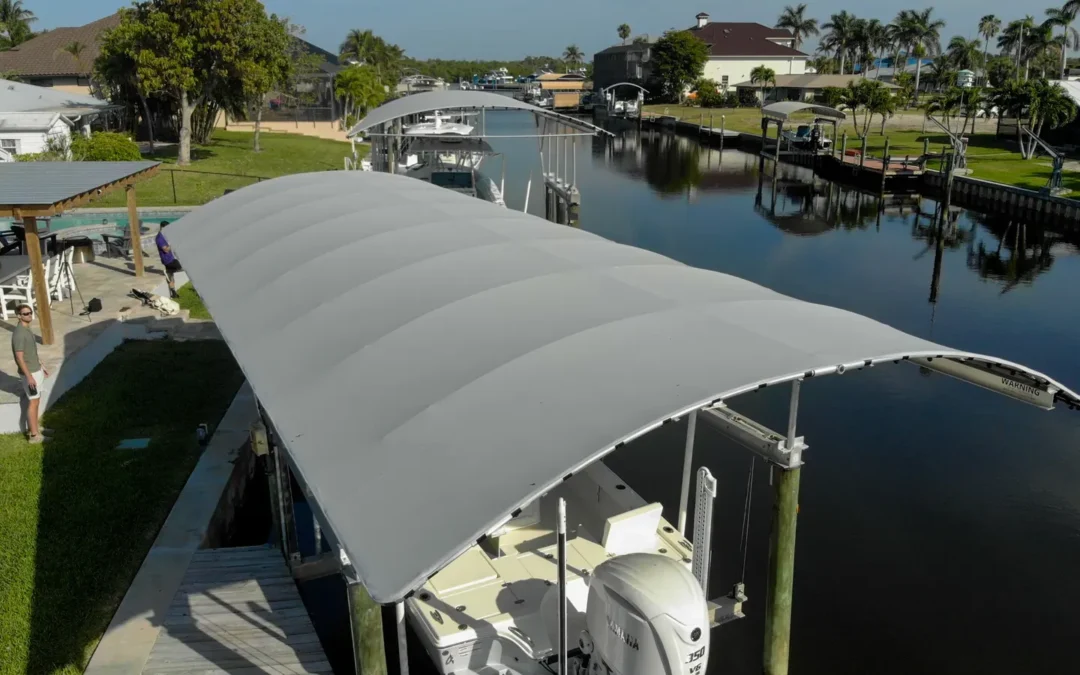
Boat Lift Canopy Parts: Everything You Need to Know
If you are pricing a replacement cover, comparing a supply kit, or trying to understand what failed on your current setup, it helps to know the boat lift canopy parts that make the whole system work. A canopy is more than fabric stretched over a frame. It is a connected system of uprights, rafters, baseplates, fasteners, bungees, marine fabric, and stitching that has to stay tight in sun, rain, salt air, and wind.
Request your free estimate and let Coastline Boat Lift Covers help you choose the right canopy parts for your boat lift, dock, and coastal conditions.
This guide breaks down each major part, explains what it does, and shows what to look for when you are ordering a replacement component or a complete canopy supply kit.
What Are the Main Boat Lift Canopy Parts?
The main boat lift canopy parts are the frame, uprights, baseplates, rafters, fabric cover, bungees or tie-downs, hardware, and stitching. Each part has a different job, but the system only protects your boat when all of them work together.
Here is the simple version:
- Frame: The structural skeleton that gives the canopy its shape.
- Uprights: Vertical supports that hold the frame above the lift.
- Baseplates: Mounting points that secure the uprights to the lift or dock structure.
- Rafters: Cross members that support the fabric and help shed water.
- Fabric: The weather barrier that blocks sun, rain, and debris.
- Bungees or tie-downs: Tensioning parts that keep the fabric tight.
- Hardware: Bolts, brackets, clamps, washers, and fasteners that hold the system together.
- Thread and seams: The stitching system that keeps fabric panels connected under stress.
For Southwest Florida boat owners, these parts need to do more than look clean on a dock. They need to handle intense UV exposure, salt-laden air, heavy afternoon rain, and seasonal storm preparation. That is why Coastline manufactures custom systems with marine-grade aluminum, durable fabric, and long-lasting stitch construction.
The Frame: The Structural Core of the Canopy
The frame is the most important structural piece of a boat lift canopy. It determines the canopy shape, clearance, overhang, wind behavior, and long-term stability. If the frame is undersized, poorly fitted, or built from weak material, even a high-quality cover will struggle.
Most canopy frames are made from aluminum because it resists corrosion better than many other metals in marine environments. The design can vary by manufacturer and style. Some use round or square tube construction, while stronger systems may use reinforced I-beam construction for added rigidity.
Coastline offers several boat lift canopy frame styles, including Dominica with I-Beam, Cayman, Barbados, and Antigua. Each style serves a different dock layout, boat height, and coverage need. A boater with a tall center console may need different clearance than a boater protecting a pontoon or bay boat.
| Frame consideration | Why it matters |
|---|---|
| Shape | Affects water runoff, dock shade, clearance, and appearance. |
| Material | Marine-grade aluminum helps resist corrosion in salt air. |
| Reinforcement | I-beam support can add strength for harsh coastal conditions. |
| Fit | A custom-measured frame reduces sagging, rubbing, and poor fabric tension. |
If you are choosing between frame designs, start with your boat height, lift width, dock layout, and exposure to wind. A professional measurement helps prevent ordering parts that technically fit but do not perform well in real conditions.
Uprights: The Vertical Support System
Uprights are the vertical posts that connect the canopy frame to the lift or dock mounting points. They set the canopy height and keep the frame positioned above the boat. When uprights are too short, the canopy may interfere with towers, antennas, or T-tops. When they are too tall or poorly braced, the canopy can become less stable.
Upright placement also affects strength. Coastline uses four uprights per side on its canopy systems, compared with the two or three upright setups often seen in lighter-duty designs. More support points can help distribute stress across the frame instead of concentrating it in a few areas.
When inspecting uprights, look for bending, looseness, corrosion around fasteners, and movement at the mounting point. A small amount of wobble can become a larger problem once wind catches the cover fabric.
Baseplates and Mounting Points: Where Stability Begins
Baseplates are easy to overlook because they are not the most visible part of the canopy. They are still critical. A baseplate transfers load from the upright into the lift or dock structure. If the baseplate is weak, loose, or attached to a compromised surface, the rest of the canopy cannot stay stable.
Good baseplate installation depends on the lift configuration, the dock layout, and the structure receiving the fasteners. Hardware must be properly sized and tightened. In coastal conditions, fasteners should be selected with corrosion resistance in mind.
During a parts inspection, check each baseplate for movement, elongated holes, missing washers, cracked surrounding material, and rust staining. If a baseplate has shifted, do not simply tighten it and move on. Find out why it moved. The issue may be incorrect hardware, storm stress, deteriorated mounting material, or a frame that is pulling unevenly.
Rafters and Cross Members: The Parts That Support the Cover
Rafters and cross members run across the canopy frame to support the fabric. Their job is to maintain the canopy shape and help rainwater drain away instead of pooling. They also keep the cover from sagging between attachment points.
When rafters are spaced correctly, the cover stays smoother and more consistent. When they are too far apart, the fabric can dip, stretch, and collect water. That extra water weight can strain the fabric, bungees, seams, and frame.
Rafter condition is especially important for DIY supply kit buyers. Before installing a replacement cover, confirm that the frame and rafter layout match the cover dimensions. A cover that is close but not correct may never tension properly.
Canopy Fabric: The Main Weather Barrier
The fabric is the part most boat owners notice first, but it depends on the frame and tensioning system beneath it. Canopy fabric protects the boat from UV exposure, rain, bird droppings, leaves, and everyday dock debris. In Florida, the fabric also has to resist heat, humidity, mildew, and strong sun.
Coastline uses Patio 500 vinyl-laminated polyester fabric for its covers. This marine-grade material is designed for outdoor protection and is available in a wide range of colors. The right fabric should be waterproof, UV resistant, tear resistant, mildew resistant, and easy to clean.
Fabric condition tells you a lot about the rest of the canopy. If the cover is sagging, pooling water, fading unevenly, tearing around attachment points, or pulling at seams, the problem may be fabric age, weak bungees, poor fit, or frame movement. For more troubleshooting examples, see Coastline’s guide to common boat lift canopy problems.
Compare Coastline’s frame and fabric options if you are deciding between a replacement cover and a full canopy system.
Bungees and Tie-Downs: Small Parts With a Big Job
Bungees, straps, and tie-downs keep the cover tight against the frame. They may be small, but they are some of the hardest-working boat lift canopy parts. Proper tension helps the fabric shed water, resist flapping, and avoid unnecessary wear.
Old bungees stretch out over time, especially in Florida heat. Once they lose elasticity, the fabric can loosen and sag. That leads to water pooling, wind movement, and stress around the cover edges. Replacing worn bungees is one of the simplest maintenance steps a boat owner can take.
When checking bungees, look for cracking, stiffness, fraying, missing hooks, uneven tension, or gaps where the cover is not pulled down evenly. Replace bungees as a set when possible so the cover tension stays balanced from side to side.
Hardware: Bolts, Brackets, Clamps, and Fasteners
Hardware connects the canopy system together. It includes bolts, nuts, washers, brackets, clamps, screws, pins, and other fasteners. Hardware may not be exciting, but it is often where a canopy starts to loosen after years of vibration, salt exposure, and weather.
Marine environments are tough on metal parts. Even corrosion-resistant hardware should be checked regularly. A missing washer or loose bracket can create movement that damages larger components over time.
Use the correct replacement hardware rather than grabbing whatever fits from a general toolbox. Correct sizing matters because fasteners carry load. If you are installing a frame kit, follow the supplied hardware layout and avoid mixing parts unless the manufacturer confirms the substitution is safe.
Thread and Seams: Why Stitching Quality Matters
Seams are where fabric panels meet, and thread is what keeps those seams intact. In a hot, sunny, saltwater environment, thread quality matters. Weak stitching can fail before the fabric itself wears out, especially around stress points.
Coastline uses GORE TENARA thread and offers a lifetime stitching guarantee on its canopy systems. That matters because UV exposure is one of the biggest enemies of ordinary thread. Long-lasting stitching helps the cover hold its shape and reduces the risk of seam failure.
When inspecting seams, look for loose threads, separated panels, puckering, and widening stitch holes. If the fabric is still in good condition but the seams are failing, the issue may be the thread rather than the cover material.
Which Parts Come in a Boat Lift Canopy Supply Kit?
A boat lift canopy supply kit may include the frame components, cover fabric, bungees or straps, mounting hardware, and installation instructions. The exact contents depend on whether you are ordering a replacement cover, a partial repair kit, or a full frame and cover package.
Before ordering, confirm these details:
- Lift width and length
- Frame style and shape
- Clearance needed for the boat, T-top, tower, or accessories
- Whether the kit includes uprights and baseplates
- Whether hardware is included or sold separately
- Fabric color and material
- Attachment method, including bungees, straps, or lacing
DIY buyers should also think about installation conditions. A frame kit can include the right parts and still be difficult to install without enough help, the right tools, or a safe dock setup. Coastline’s guide on how to install a boat lift canopy frame kit explains the process in more detail.
How Do You Know Which Canopy Parts Need Replacement?
You can often identify replacement needs by looking for looseness, sagging, corrosion, fabric wear, seam separation, and uneven tension. The key is to inspect the canopy as a system instead of assuming the most visible part is the only problem.
Use this checklist:
- Fabric is sagging: Check bungees, rafter spacing, fabric stretch, and frame alignment.
- Water is pooling: Check cover tension, canopy pitch, and rafter support.
- Frame moves in wind: Check uprights, baseplates, fasteners, and mounting surfaces.
- Cover edges are tearing: Check for uneven tension, worn bungees, sharp hardware, or poor fit.
- Seams are opening: Check thread condition and UV damage.
- Hardware is rusting or loosening: Replace with properly sized marine-suitable hardware.
If several parts are failing at once, a full replacement system may make more sense than repeated small repairs. If only bungees or a few pieces of hardware are worn, a targeted replacement may be enough.
What Makes Canopy Parts Suitable for Florida Conditions?
Florida boat lift canopy parts need to resist UV exposure, salt air, heavy rain, heat, mildew, and seasonal storm preparation. That means material quality and fit matter more than a low upfront price.
For Southwest Florida, look for:
- Marine-grade aluminum frame construction
- Strong support spacing, including enough uprights for stability
- Waterproof, UV-resistant fabric
- Reliable bungees or straps that can maintain tension
- Corrosion-resistant hardware
- UV-resistant stitching
- Custom measurement rather than one-size-fits-most sizing
Boat owners in hurricane-prone areas should also think about removal and reinstallation. A canopy is not meant to be ignored when severe weather approaches. Coastline’s Hurricane Protocol helps customers prepare their canopies before storms and reinstall them after conditions are safe.
Replacement Parts vs. a Full Canopy System
Replacement parts are a good choice when the rest of the canopy is structurally sound. A full canopy system is a better choice when the frame, fabric, hardware, and mounting points are all showing age or when the current setup never fit correctly.
| Choose replacement parts when… | Consider a full system when… |
|---|---|
| Bungees are worn but the fabric and frame are sound. | The frame is bent, loose, or undersized. |
| A few pieces of hardware are missing or corroded. | The cover sags even after tension adjustments. |
| The cover fits correctly but needs minor repair. | The fabric, seams, and hardware are aging together. |
| You know the exact frame dimensions and part requirements. | You want a custom-measured system with warranty support. |
Warranty support should also factor into the decision. Coastline backs its systems with a 10-year frame warranty, a 5-year canopy warranty, and a lifetime stitching guarantee. If you are comparing options, review what to look for in a boat lift cover warranty before choosing the lowest-priced part.
Get a free Coastline estimate for a custom canopy system, replacement cover, or supply kit built around your lift measurements.
Final Thoughts: Buy Parts That Fit the Whole System
The best boat lift canopy parts are the ones that fit your lift, boat, dock, and local conditions. A strong frame still needs the right fabric. Good fabric still needs proper tension. Reliable hardware still needs sound mounting points. When one part is mismatched, the whole canopy can suffer.
For DIY builders and replacement-part buyers, the smartest first step is measurement. Confirm the frame style, lift dimensions, boat clearance, attachment method, and condition of existing components before ordering. For homeowners who want a professionally measured and installed solution, Coastline Boat Lift Covers can help build a canopy system designed for Florida sun, salt, rain, and storm preparation.
Whether you need a single replacement part or a complete custom canopy, choose components that work together. Your boat, dock, and weekends on the water depend on it.