
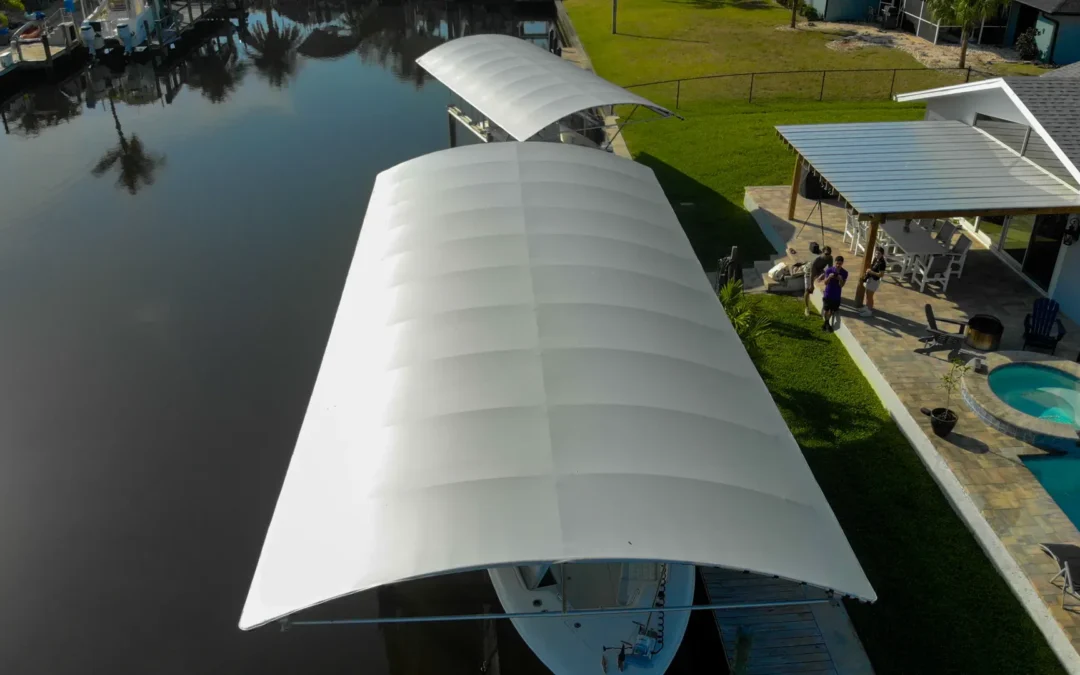
Buying a boat lift canopy is one of the best investments you can make for your vessel, but it is also one you do not want to get wrong. The canopy protects your boat from UV rays, rain, bird droppings, and falling debris every single day it sits on the lift. A poor choice means premature fabric failure, a frame that buckles in coastal winds, or an installation that never quite fits. The right questions separate a canopy that lasts a decade from one you replace in two years.
Request your free estimate from Coastline Boat Lift Covers to get answers from a team that has built custom canopy systems across Southwest Florida since 2010.
Below, we break down the specific questions you should ask any canopy provider before signing a contract. Each section covers a different part of the buying decision so nothing slips through the cracks.
Why the Right Questions Save You Money
Boat lift canopies are not one-size-fits-all products. Your dock height, lift brand, boat dimensions, local wind exposure, and even your HOA color rules all affect which canopy system will work. Asking targeted questions up front exposes the differences between vendors and helps you compare quotes on equal terms.
Skipping this step is how boat owners end up with a canopy that looks fine on paper but starts flapping loose after the first summer storm. The questions below are organized by topic so you can use them as a checklist during consultations.
What Type of Frame Construction Do You Use?
The frame is the backbone of any boat lift canopy. It carries the fabric load, resists wind uplift, and determines how long the entire system lasts. Not all frames are built the same way, and the differences matter more than most buyers realize.
Start by asking whether the frame uses I-beam construction or standard round tubing. I-beam frames use the same structural shape found in bridges and commercial buildings. They resist bending and torsion better than round tubes, which means less flex during high winds and a longer service life.
Next, ask how many uprights the frame includes per side. Some manufacturers use two uprights per side to cut costs. A system with four uprights per side distributes stress more evenly and holds up better in coastal weather. The difference shows up on windy days when cheaper frames start to bow.
Other frame questions to ask:
- What gauge aluminum do you use? Thicker gauge means stronger tubing, but it also adds weight. A good fabricator balances both.
- Is the frame custom-built for my specific lift? Pre-made frames that “close enough” fit lead to alignment issues and premature wear on the fabric.
- Do you offer different frame styles? Options like the Dominica, Cayman, Barbados, and Antigua each suit different dock configurations and boat types.
What Fabric and Thread Does the Cover Use?
The cover fabric takes the brunt of Florida’s sun, rain, and salt air every day. Asking about fabric quality is just as important as asking about the frame. A strong frame with a cheap cover still leaves your boat exposed.
Ask whether the provider uses marine-grade vinyl-laminated polyester fabric or a lighter residential-grade material. Marine-grade options like Patio 500 by Trivantage are specifically engineered for waterfront environments. They resist UV degradation, mildew, and tearing far better than generic outdoor fabric.
Thread matters just as much as fabric. Standard polyester thread breaks down under constant sun exposure. Ask if the stitching uses GORE TENARA thread, which is PTFE-based and rated to outlast the fabric itself. This is the same thread technology used in architectural sails and commercial awnings.
Additional fabric questions:
- How many color options are available? If your HOA requires a specific color to match your home or dock, you need a provider with a wide palette. Thirty or more options is a good benchmark.
- Is the fabric waterproof or just water-resistant? Waterproof coatings shed rain completely. Water-resistant fabrics let moisture seep through over time.
- Does the fabric reflect heat? A heat-reflective surface keeps temperatures lower under the canopy, which protects gel coat, vinyl seating, and electronics on your boat.
How Do You Handle Sizing and Custom Fit?
A canopy that does not fit correctly creates problems from day one. Loose fabric flaps in the wind and wears faster. A cover that is too tight puts stress on the frame joints. Proper fit starts with proper measurements.
Get a free on-site measurement and estimate so your canopy is built to your exact dock and lift specifications.
Ask whether the company sends a technician to your dock for physical measurements or relies on dimensions you provide over the phone. Professional on-site measurement accounts for variables you might miss: piling positions, dock height, clearance for T-tops or towers, and the exact make and model of your lift.
Key sizing questions include:
- Do you measure at my dock, or do I need to provide dimensions myself? On-site measurement is always more accurate.
- Can you accommodate boats with T-tops, towers, or radar arches? Some frame styles provide more vertical clearance than others.
- What if my lift is an older or less common brand? A company that services multiple lift brands has more experience adapting frames to non-standard configurations. Check whether they work with your specific lift type and setup.
What Warranty Coverage Do You Offer?
Warranty terms tell you a lot about how much a company trusts its own product. Longer warranties backed by specific coverage details usually mean better materials and construction.
Ask for exact numbers. A “limited lifetime warranty” can mean almost anything. Instead, ask these pointed questions:
- How many years does the frame warranty cover? Industry warranties range from 3 to 10 years. A 10-year frame warranty signals confidence in the materials and welds.
- How many years does the canopy fabric warranty cover? Five years is a solid benchmark for marine-grade fabric in a Florida climate.
- Is stitching covered separately? Thread failure is one of the most common canopy problems. A lifetime stitching guarantee means the company stands behind every seam.
- What does the warranty actually cover? Does it include labor for replacement, or just the material cost? Does it cover wind damage up to a certain speed? Get the details in writing.
Compare warranty terms side by side when evaluating quotes. A slightly higher upfront price with a 10-year frame warranty and lifetime stitching guarantee often costs less over the canopy’s life than a cheaper option with a 3-year warranty and no stitching coverage.
How Does Your Canopy Hold Up in Hurricanes?
If you own a boat in Florida, hurricane season is part of life. Any canopy provider who does not have a clear answer to this question should raise a red flag.
Ask whether the company offers a hurricane removal and reinstallation service. Leaving a canopy up during a major storm risks damage to the frame, the cover, your boat, and even your dock. A provider with a pre-season removal program takes that risk off your plate.
Hurricane-related questions to ask:
- Do you remove and reinstall canopies before and after storms? Pre-booking this service before hurricane season starts often costs less than emergency calls during a storm watch.
- What is the cost for removal and reinstallation? Get a flat price up front. Some companies charge significantly more for emergency service than for pre-booked seasonal removal.
- Do you store the canopy components during the storm, or do I need to handle that? Full-service providers handle storage so you do not have to find space for aluminum frames and rolled fabric.
- What wind rating does the frame carry? This tells you at what sustained wind speed the manufacturer recommends removal. Stronger frames with I-beam construction can handle more than lightweight round-tube systems.
Contact Coastline Boat Lift Covers to learn about our Hurricane Protocol, which includes pre-season removal scheduling and priority reinstallation after the storm passes.
What Does the Total Cost Include?
Price is an obvious concern, but the cheapest quote is rarely the best deal. A low number that excludes installation, measurement visits, or hardware adds up fast once the extras land on the invoice.
Ask for an all-in price that covers the frame, fabric, hardware, measurement, and installation. Then ask what is not included. This prevents surprises and makes it possible to compare vendors accurately. For a detailed cost breakdown, see our guide on how much a boat lift canopy costs.
Cost-related questions worth asking:
- Does your quote include professional installation? Some companies ship a kit and leave you to figure out the rest. Others include full installation by trained crews.
- Is the on-site measurement visit free? Reputable providers offer free estimates with no obligation.
- Are there add-on costs for color upgrades, I-beam reinforcement, or extra uprights? Know exactly what drives the price up or down so you can make informed tradeoffs.
- Do you offer any seasonal promotions? Some providers run specials during slower months, which can save several hundred dollars on a custom system.
What Is the Installation Process and Timeline?
A canopy that takes three months to arrive leaves your boat unprotected through the hottest part of the year. Understanding the timeline helps you plan around your boating schedule and Florida’s weather patterns.
Ask these questions about the process:
- How long does it take from the first measurement to completed installation? Two to four weeks is typical for a custom-built system. Anything longer than six weeks warrants an explanation.
- Who performs the installation? In-house crews who built the canopy know the product better than subcontracted labor.
- Do you handle permitting if my area requires it? Some waterfront communities and HOAs require permits for dock structures. A local provider familiar with Southwest Florida regulations can navigate this for you.
- Will you inspect my existing lift before installation? A good installer checks that your lift is level and structurally sound before mounting a new canopy system.
Can I See Examples of Your Work?
Photos, reviews, and references tell you more than any sales pitch. A company with years of installations across your area should have plenty to show.
Ask to see photos of completed projects on lifts similar to yours. Read recent Google reviews for comments about installation quality, customer service, and how the canopy held up over time. Coastline Boat Lift Covers, for example, holds a 4.7-star rating across 234+ Google reviews from boat owners throughout Southwest Florida.
You can also ask for references from customers in your specific neighborhood or marina. Local references let you see the work in person and ask the owner how the canopy has performed through storm season.
Frequently Asked Questions
What is the most important question to ask a boat lift canopy provider?
Ask about the frame construction method. The frame determines the structural strength of the entire system, and the difference between I-beam construction and standard round tubing affects how well the canopy handles wind, weight, and long-term wear. Everything else, including fabric, fit, and warranty, builds on the frame.
How do I know if a boat lift canopy will fit my boat?
The best way to confirm fit is to have a professional technician measure your dock and lift on site. They account for piling spacing, lift brand, boat height with any towers or tops, and clearance requirements. Providing your own measurements over the phone often leads to sizing errors that affect performance.
Should I remove my boat lift canopy during hurricane season?
Yes. In Florida, removing your canopy before a hurricane reduces the risk of damage to the frame, fabric, boat, and dock. Look for a provider that offers a pre-season removal and reinstallation program so you do not have to handle it yourself. Pre-booking is usually cheaper than emergency removal during a storm warning.
How long should a quality boat lift canopy last in Florida?
A well-built canopy with marine-grade fabric and a strong frame typically lasts 7 to 12 years in Florida’s climate. The exact lifespan depends on sun exposure, salt air, maintenance habits, and whether the canopy is removed during major storms. Look for a provider that offers maintenance guidance to extend the life of your investment.
What is the average cost of a boat lift canopy in Southwest Florida?
Custom boat lift canopies in Southwest Florida generally range from $2,000 to $6,000 or more depending on the frame style, fabric choice, canopy size, and whether installation is included. Get quotes from at least two providers and compare what each price covers before making a decision. Our boat lift canopy cost guide breaks down the factors that affect pricing.
Your Checklist Before You Buy
Print this list or save it on your phone before your next consultation:
- What frame construction method do you use (I-beam vs. round tube)?
- How many uprights per side does the frame include?
- What fabric and thread do you use?
- Do you measure at my dock or require me to provide dimensions?
- What are your exact warranty terms for the frame, fabric, and stitching?
- Do you offer hurricane removal and reinstallation services?
- Does the quote include measurement, materials, and installation?
- How long is the lead time from measurement to completed install?
- Can I see photos and reviews from local customers?
Walking into a consultation with these questions puts you in control of the conversation and makes it much easier to tell which provider is offering real value versus cutting corners.
Ready to get started? Request your free estimate from Coastline Boat Lift Covers and let our team answer every question on your list.