
Your Complete Pre-Season Guide for Southwest Florida
Florida’s hurricane season officially runs from June 1 through November 30, but smart boat owners in Southwest Florida start preparing months earlier. Your boat lift canopy is one of your most valuable waterfront investments, and a structured pre-season checklist is the difference between riding out hurricane season with confidence and scrambling when a named storm appears in the Gulf.
This checklist covers everything you need to inspect, maintain, repair, and plan before the first tropical system threatens Fort Myers, Cape Coral, Marco Island, or anywhere in Southwest Florida.
Phase 1: Frame Inspection (March-April)
Start your hurricane preparation with a thorough inspection of your canopy frame. This is the structural backbone of your boat lift cover system. Learn more about I-beam vs. standard tube frames, and any weakness here becomes a failure point in high winds.
Structural Integrity Check
- Inspect all frame joints and welds. Look for hairline cracks, corrosion, or separation at welded connections. I-beam frames like those used by Coastline Boat Lift Covers offer superior wind resistance, but even the strongest frames need periodic inspection.
- Check baseplates and mounting hardware. Each baseplate should be firmly secured to the boat lift structure. Loose mounting bolts allow the frame to shift under wind load, creating stress points that can lead to collapse.
- Examine uprights for straightness. Bent or bowed uprights indicate the frame has been stressed beyond its normal load capacity. This can happen from a previous storm, impact damage, or gradual fatigue over years of service.
- Look for corrosion. Aluminum frames resist rust, but saltwater exposure can cause pitting and oxidation over time. Focus on areas where different metals contact each other (galvanic corrosion) and any spots where protective coatings have worn through.
When to Call for Professional Inspection
If you notice any of the following, schedule a professional frame inspection before hurricane season:
- Visible cracks at weld points
- Baseplates that move when pushed by hand
- Uprights that are visibly bent or misaligned
- Significant corrosion on more than 10% of the frame surface
- Frame components that make grinding or creaking sounds in normal wind
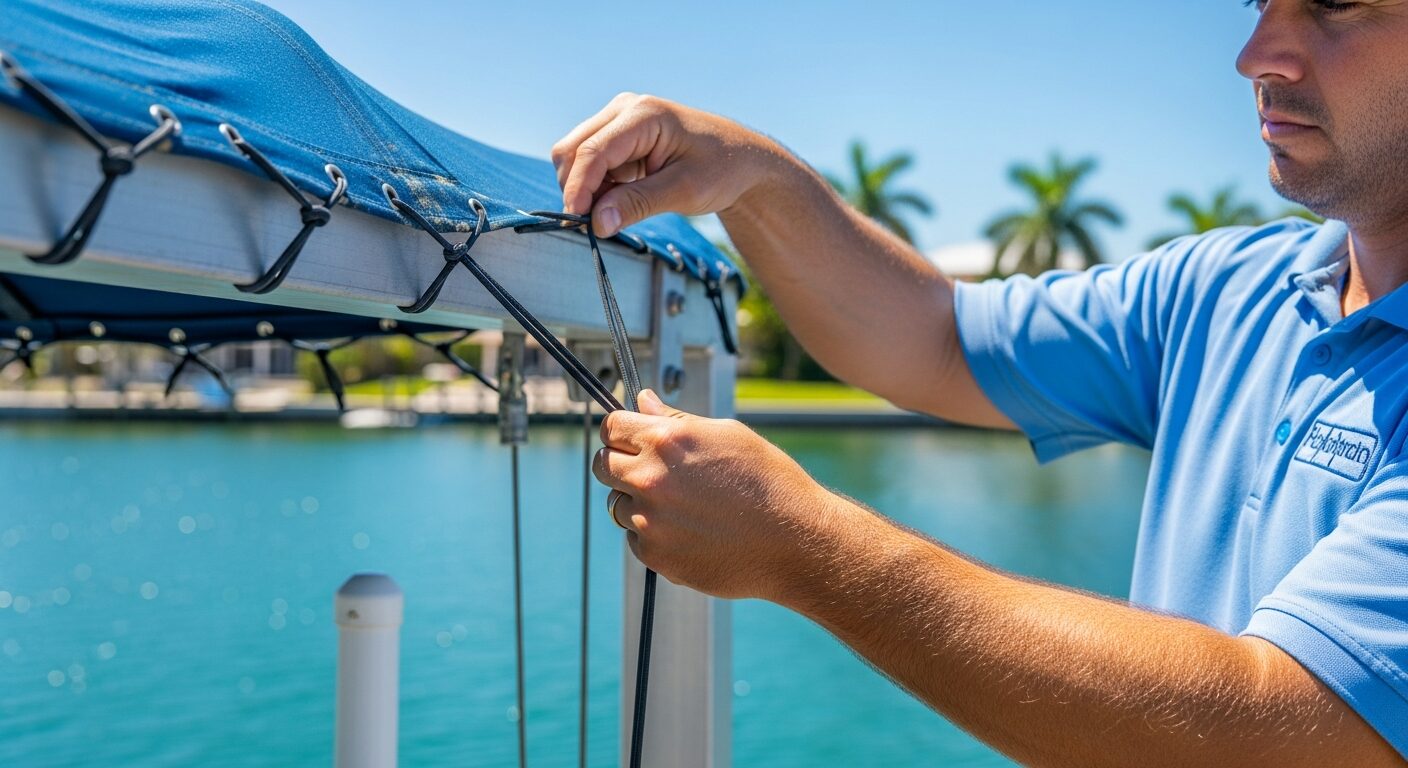
Phase 2: Canopy Fabric and Attachment Check (April-May)
Your canopy fabric is your first line of defense against sun, rain, and wind. Inspect it thoroughly before hurricane season adds extreme stress.
Fabric Condition Assessment
- Check for tears, holes, or thin spots. Hold the fabric up to sunlight if possible. Any areas where light passes through more than the surrounding material indicate fabric degradation.
- Inspect seams and stitching. Run your hand along all seams, feeling for loose thread, puckering, or separation. Coastline canopies use GORE TENARA thread with a lifetime stitching guarantee, but other brands may use thread that degrades under UV exposure.
- Look for mold or mildew. Dark spots or a musty smell indicate mold growth. While this does not affect structural integrity immediately, it can weaken fabric fibers over time. Clean affected areas with a mild soap solution and rinse thoroughly.
- Test fabric tension. The canopy should sit snugly on the frame without sagging or excessive pooling areas where water could collect.
Bungee Inspection and Replacement
Bungees are the critical connection between your canopy fabric and the frame. Failed bungees during a pre-hurricane removal can slow down the process. See our guide on canopy repair vs. replacement for more details and create complications.
- Check elasticity. Stretch each bungee by hand. It should snap back immediately with consistent tension. If a bungee feels stiff, stretched out, or does not return to its original length, replace it.
- Inspect hooks and attachment points. Look for rust, bending, or deformation on bungee hooks. Check the frame attachment points (grommets or rails) for wear.
- Replace all bungees at once. If more than 20% of your bungees need replacement, replace the entire set. Mixed-age bungees create uneven tension across the canopy, leading to premature wear.
- Coastline replacement bungees are available as part of our maintenance service. New bungee replacement without reinstallation is $250.
Phase 3: Insurance and Documentation (May)
Before hurricane season starts, make sure your paperwork is in order.
Photography and Documentation
- Photograph your entire boat lift system from multiple angles: frame, canopy, hardware, baseplates, and the boat itself. Take these photos on a clear day with good lighting.
- Document serial numbers and model information for your canopy frame and cover. Store this information digitally (cloud storage or email to yourself).
- Save purchase receipts and warranty documents. Coastline provides a 10-year frame warranty and 5-year canopy warranty. Having these documents accessible speeds up any post-storm claims.
Insurance Review
- Verify your homeowner’s policy covers boat lift canopy damage. Many standard policies have exclusions for marine equipment. Ask your agent specifically about boat lift covers and frames.
- Check your boat insurance for hurricane provisions. Some marine insurance policies require specific storm preparation steps (like canopy removal) to maintain coverage.
- Document your pre-season inspection with photos and notes. This demonstrates due diligence to insurance adjusters if you need to file a claim.
Phase 4: Hurricane Removal Plan (May-June)
Do not wait for the first named storm. Have your removal plan locked in before June 1.
Professional Removal Reservation
- Sign up for the Coastline Hurricane Removal Program. Pre-booking guarantees your spot on our priority removal list and locks in standard pricing.
- Confirm contact information with your removal service. Make sure they have a current phone number and email, plus a secondary contact if you plan to travel during hurricane season.
- Discuss access arrangements. If you will be out of town, provide your removal team with dock access details. Coastline handles removal even when you are away and invoices you after the job is complete.
DIY Removal Backup Plan
Even with professional removal scheduled, know how to do it yourself in case a fast-moving storm outpaces the removal timeline:
- Disconnect all bungees from frame hooks
- Detach canopy fabric from frame rails
- Accordion fold from the back (offshore side) to center
- Accordion fold from the front (seawall side) to center
- Roll tightly from the offshore side
- Secure with straps and store indoors (not on the dock)
Storage Preparation
- Identify a dry, indoor storage location for your rolled canopy. A garage, storage unit, or interior room works best.
- Never store a canopy on the dock or boat lift during a hurricane. Storm surge can carry unsecured items into the water.
- Store bungees separately in a sealed bag to prevent UV degradation during the off-season.
Phase 5: Active Storm Season Monitoring (June-November)
Tracking Resources
- NOAA National Hurricane Center (nhc.noaa.gov): Official forecast and advisory source
- National Weather Service Fort Myers (weather.gov/mfl): Local forecasts and warnings for Southwest Florida
- Lee County Emergency Management and Collier County Emergency Management: Local evacuation and shelter information
Decision Timeline
| Timeframe | Action |
|---|---|
| Tropical disturbance identified | Monitor forecasts; review your removal plan |
| Tropical storm watch issued (48 hours out) | Contact your removal service; begin securing loose dock items |
| Tropical storm warning or hurricane watch (36 hours out) | Canopy should be removed or removal in progress |
| Hurricane warning (24 hours out) | Canopy must be off; secure boat on lift; evacuate if ordered |
| All clear issued | Wait for professional inspection before reinstallation |
The 70 MPH Rule
Your boat lift canopy must be removed when sustained winds are forecast to reach 70 MPH or higher. This is not optional. Even the most durable marine-grade frames and fabrics cannot withstand sustained hurricane-force winds with the canopy attached. Removing the fabric protects the frame, your boat, and neighboring properties.
Phase 6: Post-Storm Recovery
After the Storm Passes
- Do not reinstall your canopy immediately. Wait for your professional service to inspect the frame for hidden storm damage. Follow our boat lift cover maintenance guide for post-storm care.
- Inspect the boat lift structure before putting any load on it. Check pilings, cross members, and lift cables.
- Document all damage with photos before touching or moving anything. This is critical for insurance claims.
- Contact Coastline to schedule your reinstallation. We typically begin reinstallation within 48-72 hours after a storm clears the area.
Do Not Wait for the Forecast to Change
Every year, Southwest Florida boat owners tell us the same thing: “I wish I had signed up earlier.” Pre-booking your hurricane removal is the single most effective step you can take to protect your boat lift canopy during storm season.
Get on the list now:
– Request a Free Estimate
– Call: (239) 994-3047 (Fort Myers) or (239) 494-6968 (Cape Coral)
– Email: office@coastlineboatliftcovers.com
Coastline Boat Lift Covers serves Fort Myers, Cape Coral, Marco Island, Bonita Springs, Naples, Punta Gorda, Port Charlotte, and Estero Island. We remove and reinstall canopies from any manufacturer, not just our own.