
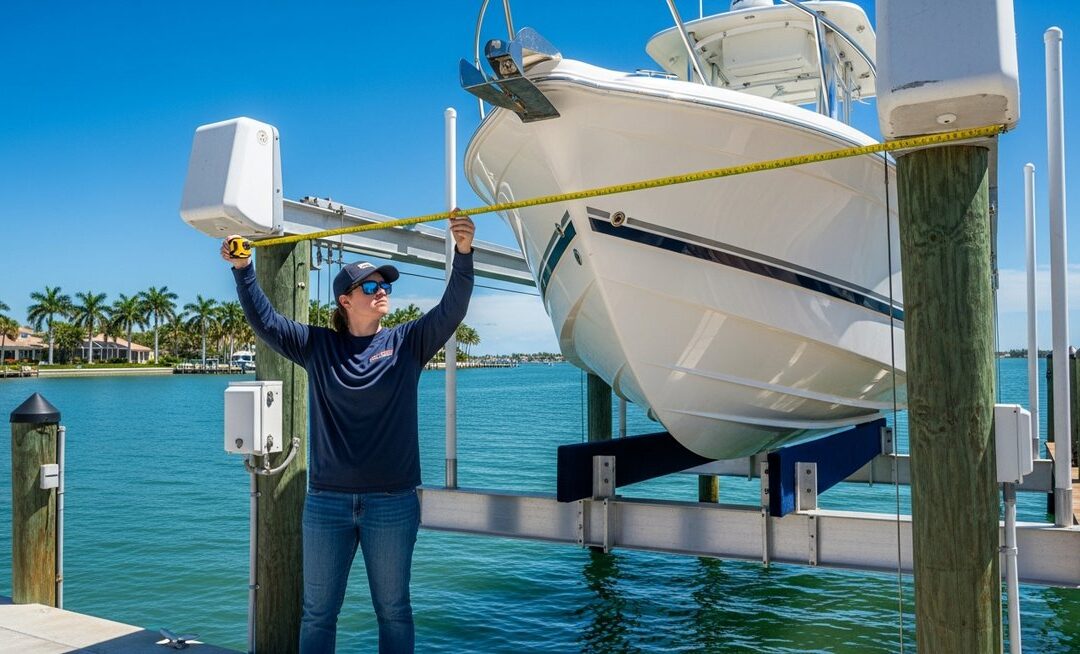
Ordering a boat lift canopy that doesn’t fit is an expensive mistake. Covers that are too loose pool water, flap in the wind, and wear out fast. Covers that are too tight stress the frame and rip at the seams. Getting accurate measurements before you order is the single most important step in the process. This guide walks you through exactly how to measure your boat lift canopy so you get a perfect fit the first time, whether you’re replacing an old cover or starting from scratch.
Key Takeaways
- Accurate boat lift measurements prevent costly mistakes. Taking the time to measure your lift’s width, length, and height correctly ensures your new canopy fits snugly without sagging, pooling, or wind damage.
- You need just a few basic tools to get started. A tape measure, a helper, a notepad, and a marker are all it takes to capture the dimensions your canopy manufacturer needs.
- Professional measurement services eliminate guesswork. If your lift has an unusual configuration or you want guaranteed accuracy, a free estimate from an experienced crew is the fastest path to a perfect fit.
Why Proper Measurements Matter for Boat Lift Covers
A custom boat lift cover is only as good as the measurements behind it. When a canopy is built to your lift’s exact specifications, it drapes evenly across the frame, sheds water efficiently, and resists wind uplift. When the numbers are off by even a few inches, problems start compounding.
An oversized cover creates low spots where rainwater collects. That standing water adds weight, stretches the fabric, and accelerates wear. An undersized cover pulls tight against the frame, putting constant stress on stitching and attachment points. In Florida’s coastal conditions, where afternoon storms and strong gusts are routine, a poorly fitted cover simply won’t last.
Getting your boat lift measurements right also affects your canopy’s appearance. A well-fitted cover looks clean and professional on the dock. It signals that you take care of your property and your investment.
Tools You’ll Need Before You Start
Before climbing onto your dock, gather these items:
- 25-foot tape measure (or longer, depending on your lift size)
- A helper to hold the other end of the tape
- Notepad and pen to record each measurement on the spot
- Painter’s tape or a marker to label reference points on the frame
- A camera or phone to photograph your lift from multiple angles
Take photos of the full lift from the front, back, and both sides. Capture close-ups of the mounting hardware, the top of the uprights, and any brackets or I-beam connectors. These reference images help your canopy manufacturer understand your setup and verify your measurements.
Step-by-Step Guide to Measuring Your Boat Lift
Step 1: Measure the Width (Beam)
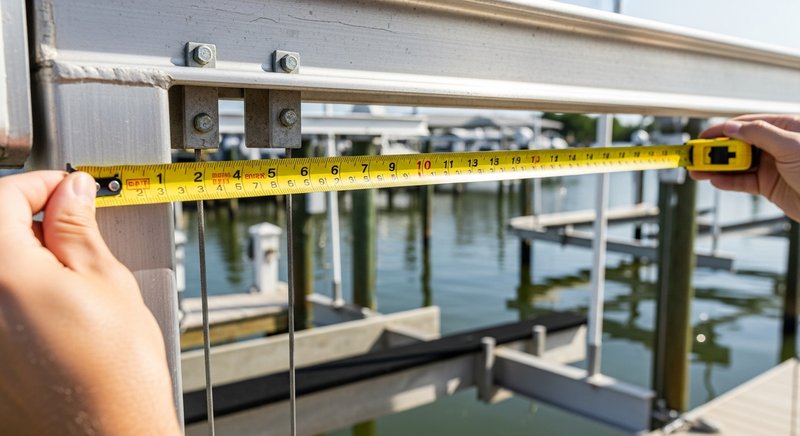
The width measurement runs across the shorter dimension of your lift, from one side to the other.
- Stand at one end of the lift and locate the outside edge of the left upright.
- Have your helper hold the tape at that point.
- Pull the tape straight across to the outside edge of the right upright.
- Record this measurement in feet and inches.
Important: Always measure to the outside edges of the uprights, not the inside. Your canopy frame needs to extend beyond the structural supports to provide full coverage. If your lift has I-beam construction like Coastline’s Dominica frame, measure to the outermost point of the I-beam flange.
Step 2: Measure the Length (Fore to Aft)
The length measurement runs along the longer dimension of your lift, parallel to the boat.
- Move to one side of the lift.
- Find the outside edge of the front upright.
- Run the tape to the outside edge of the rear upright on the same side.
- Record the measurement.
- Repeat on the opposite side to check for symmetry.
If the two sides differ by more than an inch, note both numbers. Older lifts or those on pilings that have shifted over time can have slight variations that matter for a custom fit.
Step 3: Measure the Height
Height determines how much clearance your canopy provides above the boat and how the fabric drapes.
- Measure from the top of the upright (where the canopy frame sits) down to the dock surface or waterline.
- Record this measurement on each corner, since dock surfaces can be uneven.
For frame styles with overhang like the Barbados (12 to 30 inches of extra coverage), you’ll also want to note how much additional drop you’d like on each side.
Step 4: Note Your Lift’s Brand and Model
Your lift’s manufacturer and model number are critical details. Different brands position their crossbeams, cables, and motor assemblies in different spots, which affects where the canopy frame mounts and how the cover attaches.
Look for a label or stamped plate on the main beams of your lift. Common lift brands in Southwest Florida include:
- Deco Boat Lifts
- Golden Boat Lifts
- HydroHoist
- Neptune Boat Lifts
- DAKA
If you can’t find a label, measure the beam cross-section dimensions and take a photo. An experienced canopy manufacturer can usually identify the lift type from these details.
Step 5: Document Any Obstructions
Walk around your lift and look for anything that could interfere with canopy placement:
- Pilings or dock posts that sit close to the lift structure
- Electrical conduit or wiring running along the beams
- Boat lift motors and control boxes mounted on top of the frame
- Lighting fixtures attached to the lift or dock
- Seawall or dock edges that limit how far the canopy can extend
Mark these on your notepad with approximate distances from the nearest upright. Your canopy provider needs to know about these obstructions to design a frame that works around them.
Common Measurement Mistakes to Avoid
Even experienced boat owners make these errors when measuring for a new canopy:
Measuring inside edge to inside edge. This gives you a number that’s too small. Always go outside edge to outside edge of the uprights.
Forgetting about the motor. Boat lift motors often sit above the frame on one end. If your canopy needs to clear the motor housing, you’ll need extra height in that area.
Ignoring tidal variation. If your lift is in a tidal zone, measure at both high and low tide. The waterline position affects how much clearance the boat needs under the canopy.
Rounding to the nearest foot. Inches matter when you’re ordering a custom cover. A 14-foot, 3-inch measurement is not the same as 14 feet. Record exact numbers.
Not checking for level. Just because a lift looks straight doesn’t mean it is. Use a level on the top beams if possible, or measure the height at each corner. Settling pilings can create a slope that affects canopy fit.
When to Hire a Professional for Measurements
For most standard boat lifts, a careful DIY measurement works fine. But some situations call for a professional:
- Your lift is older or has been modified. Non-standard configurations need an expert eye to identify the best canopy mounting approach.
- You’re ordering a premium frame style. If you’re investing in a Dominica I-beam canopy or another high-end frame, professional measurement ensures every dollar is well spent.
- Access is difficult. Lifts on deep-water docks, elevated seawalls, or in tight canal setups are hard to measure safely without proper equipment.
- You want it done once, done right. A professional measurement eliminates the back-and-forth of re-orders and adjustments.
Coastline Boat Lift Covers offers free on-site estimates across Southwest Florida. A trained crew member visits your dock, takes precise measurements, documents your lift configuration, and provides a custom quote, all at no cost. For boat owners in Fort Myers, Cape Coral, Marco Island, Bonita Springs, and surrounding areas, this is the fastest way to get a canopy that fits perfectly.
What Happens After You Submit Your Measurements
Once your dimensions are in hand, your canopy manufacturer uses them to:
- Select the right frame style based on your lift type and coverage preferences. Coastline offers four distinct canopy frame styles, from the heavy-duty Dominica to the versatile Cayman, each designed for different dock setups.
- Choose fabric and color. Marine-grade Patio 500 fabric comes in 30 colors to match your home, dock, or HOA requirements. The vinyl-laminated polyester is waterproof, UV-resistant, and built to handle Florida’s intense sun and salt air.
- Engineer the frame to your specifications. Custom frames mean the rafter spacing, upright placement, and overhang are all tailored to your measurements, not pulled from a generic template.
- Schedule installation. Professional installation crews mount the frame and stretch the cover for a tight, clean fit that sheds water properly and resists wind.
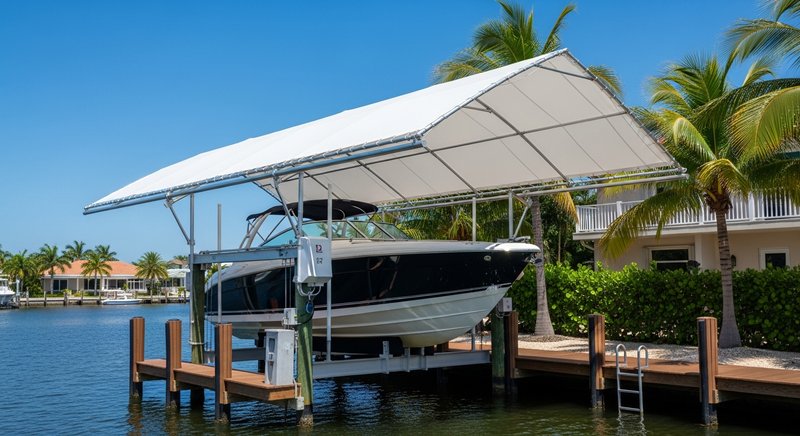
The difference between a custom-measured canopy and an off-the-shelf cover is night and day. Custom means no sagging, no pooling, no gaps, and a warranty that backs it up. Coastline provides a 10-year frame warranty, 5-year canopy warranty, and a lifetime stitching guarantee on every installation.
Preparing Your Boat Lift for Canopy Installation
Once your measurements are confirmed and your order is in, a few simple steps help ensure a smooth installation day:
- Clear the dock area around the lift so the installation crew has room to work.
- Remove any temporary covers or tarps from the lift frame.
- Lower the lift to a comfortable working height if possible.
- Secure your boat so it won’t drift or shift during installation.
- Check that electrical power to the lift motor is accessible if the crew needs to operate it.
For Florida boat owners who also want to protect their canopy investment during hurricane season, ask about pre-booking removal and reinstallation services when you schedule your installation. Planning ahead locks in standard pricing before named storms drive up demand.
Frequently Asked Questions
What measurements do I need for a boat lift canopy?
You need three core measurements: width (outside edge to outside edge of the uprights), length (front to back along the longest dimension), and height (top of upright to dock or waterline). You should also note your lift’s brand, model, and any obstructions like motors, pilings, or wiring.
Can I measure my boat lift myself?
Yes. Most standard boat lifts can be measured by a homeowner with a tape measure and a helper. Follow the step-by-step process in this guide to capture accurate dimensions. For complex setups, consider a free professional estimate.
How long does it take to get a custom boat lift cover after measurements?
Turnaround varies by manufacturer and season. Custom covers built in-house, like those at Coastline’s Fort Myers facility, typically have faster lead times than covers shipped from out of state. During peak season (spring and early summer), ordering early is recommended.
What if my measurements are slightly off?
Small discrepancies of a quarter inch or less are usually absorbed by the fabric’s stretch and the attachment hardware’s adjustment range. Errors of an inch or more can affect fit, drainage, and wind resistance. When in doubt, remeasure before ordering or request a professional measurement.
Do I need different measurements for a replacement cover vs. a new frame?
If you’re replacing just the cover on an existing frame, measure the frame itself, not the old cover. Fabric stretches over time, so old cover dimensions won’t reflect the true frame size. If you’re replacing both the frame and cover, measure the lift structure as described in this guide.